
The most valuable thing a consumer has today is their decision
Today’s consumers are overwhelmed by choice, doubt, and information noise. We explain how brands can reduce friction, simplify the path to purchase, and help people feel more confident in their decisions.
We live in an age where choices are literally everywhere—and that has become a new source of stress. A person opens an app to buy a pair of ordinary sneakers and spends forty minutes comparing nine options. They visit a website—and leave because they don’t know what to do next. They see an ad—and don’t believe it because it’s too good to be true.
This isn’t a problem specific to any one brand. It’s the new reality of the consumer, who is simultaneously pragmatic, exhausted, and skeptical—yet still wants to make the right choice.
Brands that understand this and act accordingly are growing. Those that continue to compete on the basis of noise and the size of discounts are running out of steam.
What’s happening with the Ukrainian consumer
The data paints a clear picture. At the start of 2025, there were 31.5 million internet users in Ukraine. Social platforms reach 21.6 million unique users. 56% of people shop online several times a month or more often. The advertising market grew by 12% in 2025 and is projected to grow another 13% in 2026—with search, SMM, influencer marketing, and SEO showing double-digit growth.
But behind the growth figures lies a more complex picture.
Consumers have become more price-conscious, but that doesn’t mean they only buy cheap products. They buy where they see clear value and where they don’t have to go out of their way to see it. Convenience and care have become the second most important factor after price—and this gap is narrowing.
At the same time, the psychological context is significant: studies show signs of burnout and a growing need for self-care and so-called “small pleasures.” Online shopping is increasingly serving not just as a way to make purchases, but as a quick way to regain a sense of normalcy and control over the situation.
And here’s another game-changing fact: more than half of all purchases are made omnichannel. Only 12% of offline sales are completely unaffected by digital channels. People Google, watch videos, read reviews in messaging apps, visit a store, go home, and buy online—or vice versa. There is no longer a linear path.
MIM:AGENCY’s Core Insight
“When life feels overwhelming, people aren’t just buying a product—they’re buying a sense of control”
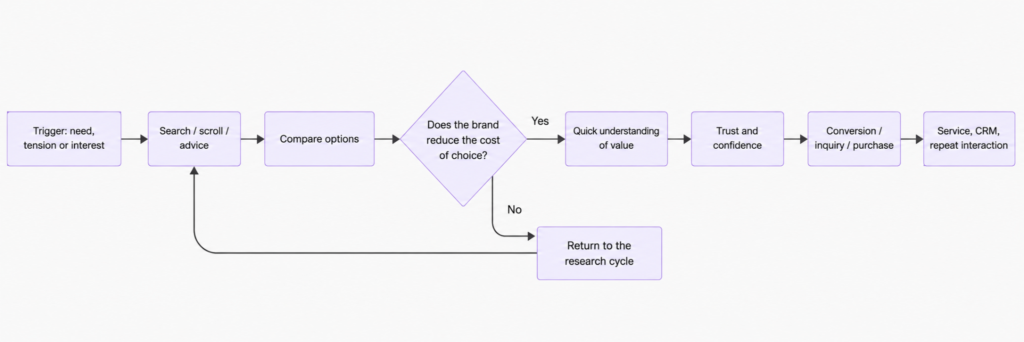
A brand grows when it reduces the cost of choice: by speaking honestly, simplifying the process, and delivering a small but tangible win right now.
This isn’t about becoming a “trusted brand” in an abstract sense. Nor is it about simply being visible or cheap. It’s about a very specific operational matter: at every step of the consumer’s journey, the brand must relieve tension, not add to it. Answer questions before they’re asked. Make the next step obvious. Confirm that the person made the right choice.
This is where the competitive advantage lies—not in the media budget, but in the quality of the experience along the entire journey, from the first touch to repeat purchase.
| Micro-insight | What the data shows | Practical takeaway |
| Price matters, but not on its own | Price lists, discounts, and special offers remain key triggers, but the second layer of need is convenience and care: a simple path, ready-made solutions, and time savings. In international CX data, a high price is the main stop factor, but poor service is already the second one. | Do not communicate only “cheaper”; sell the simplicity of the solution and visible care. |
| Stress turns usefulness into emotional value | Ukrainian studies show exhaustion, a growing need for self-care, and “small joys”; online shopping is increasingly working as a quick way to restore a sense of normality and control. Fifty-six percent shop online several times a month or more often. | A brand should provide not just function, but also relief: fewer doubts, fewer steps, less tension. |
| The path to purchase is non-linear and cross-channel | A purchase is less and less likely to be “purely online” or “purely offline”; in omnichannel research, fifty-two percent of purchases were omnichannel, and only twelve percent of offline sales had no digital influence. Consumers want to feel they are making the right choice, and confident buyers have higher value and are much more willing to recommend a brand. | The insight should not live in a single slogan, but in a chain of proof points throughout the entire journey, from search to service. |
| Trust is now earned through relevance in action | People trust brands they already use more, but they expect relevance, responsiveness, clarity of action, and personal consistency from them. At the same time, seventy-one percent of customers are more protective of their personal data. | A simple formula is needed: personalization in exchange for clear value, without intrusiveness and without “purpose emptiness.” |
| Idealized advertising loses to truthful positivity | Only nine percent respond positively to advertising with an “idealized” picture of life. People want “good news from the real world.” At the same time, content consumption has shifted toward entertainment, while news is often consumed through messengers, social media, and video platforms. | The tone should be warm but grounded: real scenes, real barriers, real small wins. |
Why This Insight Is More Than Just a Nice Idea
Only 9% of consumers respond positively to ads that paint an idealized picture of life. People want “good news from the real world”—warm, yet down-to-earth. Real scenes, real obstacles, real small victories.
At the same time, 71% of users have become more vigilant about protecting their personal data—which means that personalization without a clear exchange of value is perceived as an intrusion, not a gesture of care.
Confident buyers—those whom the brand has helped make a decision without hesitation—have significantly higher value and are much more likely to recommend the brand to others. This isn’t a soft metric: it’s a direct impact on growth.
And one more important nuance: poor service is now the second most significant deal-breaker after high prices. A promise not backed by experience isn’t just useless—it’s harmful.
Creative Approaches and Activations
The three approaches that best translate this insight into creative work stem directly from audience behavior: what’s needed isn’t abstract imagery, but a combination of control, realistic positivity, and practical utility.
| Creative direction | Core idea | What it should look like |
| Fewer doubts | The brand helps people understand faster what to choose and why | Comparisons, FAQs, “what’s included” sections, calculators, and scenarios such as “which option fits me best” |
| Good news from real life | The brand does not pretend the world is perfect, but shows small, real wins | Non-glossy stories, everyday situations, a simple human tone, and a visible result |
| Service as brand proof | Experience and usefulness become part of the idea, not an afterthought | Reminders, simple forms, transparent terms, human support, and a quick next step |
| Specific activation | Channels | Tone | KPI |
| Decision Relief Hub, a landing page or a series of landing pages that remove choice barriers | SEO, paid search, owned site, CRM emails, explanatory creator or expert content | Calm, evidence-based, direct | Search CTR, depth rate, page CVR, assisted conversions, share of branded search |
| Real-Life Wins, short stories built around “one less hassle, one more point of control” | Short-form video, messengers, email, remarketing, DOOH where relevant | Warm, grounded, non-glossy | VTR, saves and shares, positive sentiment, ad recall, uplift in branded searches |
| Service Beats Slogan, a service layer built on top of the campaign | Website or app, chat or messenger, email/SMS, CRM automation, human handoff | Useful, transparent, human | Completion rate, cart or lead recovery, CSAT, NPS, repeat rate, time to target action |
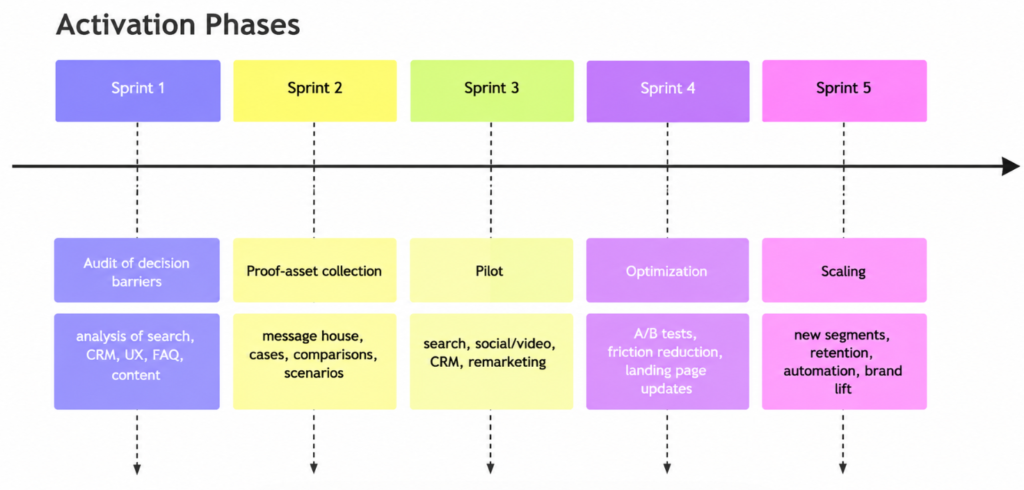
Since the timeline is not set in stone, it’s best to adopt a phased launch strategy rather than a fixed schedule: first, friction diagnostics; next, a proof-of-concept; then a pilot; and only then scaling up. This is particularly important for agencies with an integrated approach, where communication must be synchronized with UX, content, and CRM.
The three pillars of effective communication
- Honesty about reality. Not a glossy image, but tangible benefits. Not “best in class,” but “here’s what you’ll get, here’s how much it costs, here’s what happens next.” An audience living in a state of skepticism responds to directness and specifics—and punishes empty promises by walking away.
- A simple next step. The brand must answer the question “what should I do next?” before it’s even asked. Every touchpoint—a page, an email, an ad, customer support—should remove one friction point, not create a new one. Fewer steps to action mean more conversions and more trust at the same time.
- Care that shows in action. Not a mission statement on the “About Us” page, but a tangible experience: a quick and personal response, transparent pricing with no surprises, a hassle-free return process, and reminders at the right moment. It is the service that becomes the brand’s most compelling proof—and it is the service that turns a one-time purchase into a relationship.
| Messaging pillar | What to say | What to avoid |
| Honest about reality | “Here is what you get, here is the benefit, and here are the limitations” | Glossy overpromise, abstract optimism |
| Make the next step simple | “Here is how it works, how much it costs, and what to do next” | A complicated path, small print, hidden terms |
| Care that can be felt | “We save you time, reduce tension, and help you avoid mistakes” | Faceless automation, mechanical personalization |
How this works in practice
The insight about reducing choice isn’t just a slogan—it needs to permeate the entire customer journey. That’s why the implementation isn’t structured as a standalone campaign, but as a system.
- The first stage is an audit: where exactly does the consumer stop, hesitate, or leave? Search queries, CRM data, website behavior, and typical support questions—all of this reveals where the brand is losing customers and why.
- The second stage involves gathering evidence: comparisons, “which option is right for me” scenarios, transparent terms, real-life case studies, and clear FAQs. Not content for content’s sake, but answers to real barriers.
- The third stage is a pilot across key channels: search, short-form video, CRM, and remarketing. Not broad reach for the sake of reach, but testing: where exactly the brand best dispels doubts and accelerates decision-making.
- Next comes data-driven optimization and scaling to new segments, with automation where it enhances—not replaces—human care.
| Risk / objection | What could go wrong | How to reduce the risk |
| “This is just a price-first strategy” | The brand slides into a discount race | Always pair the benefit with convenience, service, and proof |
| “The tone will become too grounded and unemotional” | Communication becomes dry | Use grounded positivity: real scenes plus a small win |
| “The insight will stay only in copywriting” | UX, CRM, and service will contradict the promise | Work through a cross-functional link: strategy plus UX plus CRM plus analytics |
| “Personalization will cause rejection” | The audience will perceive the brand as intrusive | Explain the value exchange, ask for permission, and provide an easy opt-out |
A message that resonates
Less doubt—more control.
A brand that helps you take the right step—without the noise, without hidden conditions, without empty promises. Simply clear, useful, and right here, right now.
