
Google Marketing Live 2026: What It Means for Your Business
Google Marketing Live 2026 showed how Gemini, AI-powered ads, Universal Cart, YouTube, and new analytics tools are changing the logic of search, eCommerce, and digital marketing. We break down the key updates and explain what businesses should prepare for now.
Google Marketing Live 2026 turned out to be more than just another conference featuring updates to advertising tools. It was a presentation of a new reality—and the MIM:AGENCY team carefully analyzed every announcement to understand exactly what is changing and what businesses should do about it right now.
Google is no longer just an advertising platform. It is becoming the infrastructure for all commerce
Over the course of two hours of presentations, the company outlined the next technological cycle: Gemini is becoming the central layer between the user, the business, content, and the purchase. Search, advertising, analytics, eCommerce—all of this is now a single AI system, rather than a set of separate tools. This isn’t a gradual evolution—it’s a shift in logic.
Ads are being embedded directly into the AI response—and that changes everything
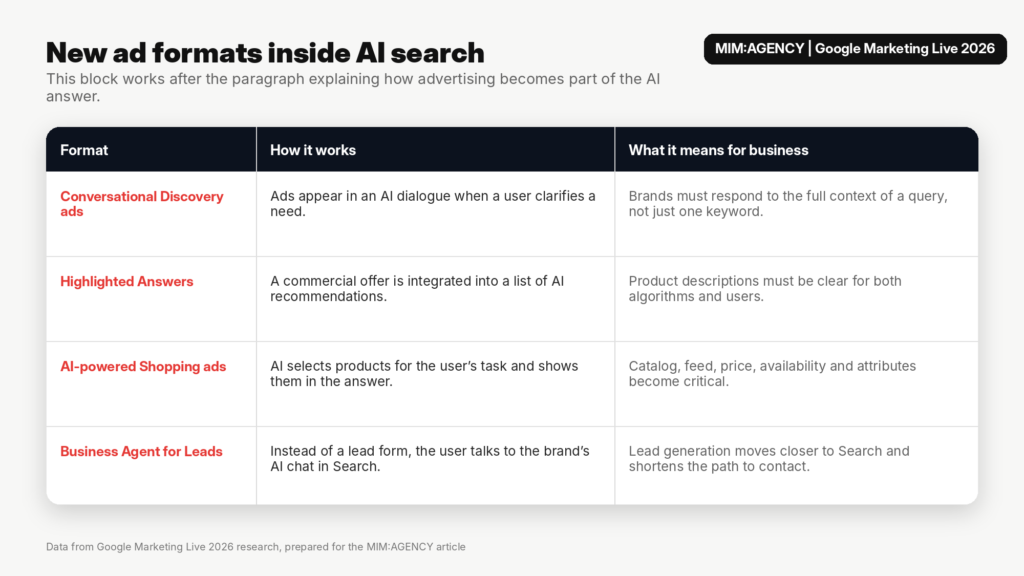
The most important thing happening with search: ads are no longer just banners next to the results. Google has announced new formats for AI Mode—Conversational Discovery ads, Highlighted Answers, and AI-powered Shopping ads—which integrate directly into the AI response.
Here’s how it works in practice: a user asks Gemini how to make their home feel like a spa. In response, the AI generates a curated selection of products, explaining why each one fits the query. The ad is part of this response—organically, without banners or separate blocks.
The new Highlighted Answers format allows you to insert advertising offers directly into AI recommendation lists. Business Agent for Leads completely replaces the standard contact form—now users can chat with the brand’s AI directly in search results without visiting the website.
What this means for business: traditional SEO and classic search advertising will continue to exist, but the center of gravity is shifting. If your business isn’t represented in AI answers—you simply don’t exist in the new search logic.
Universal Cart: Google wants to become the place where the entire transaction takes place
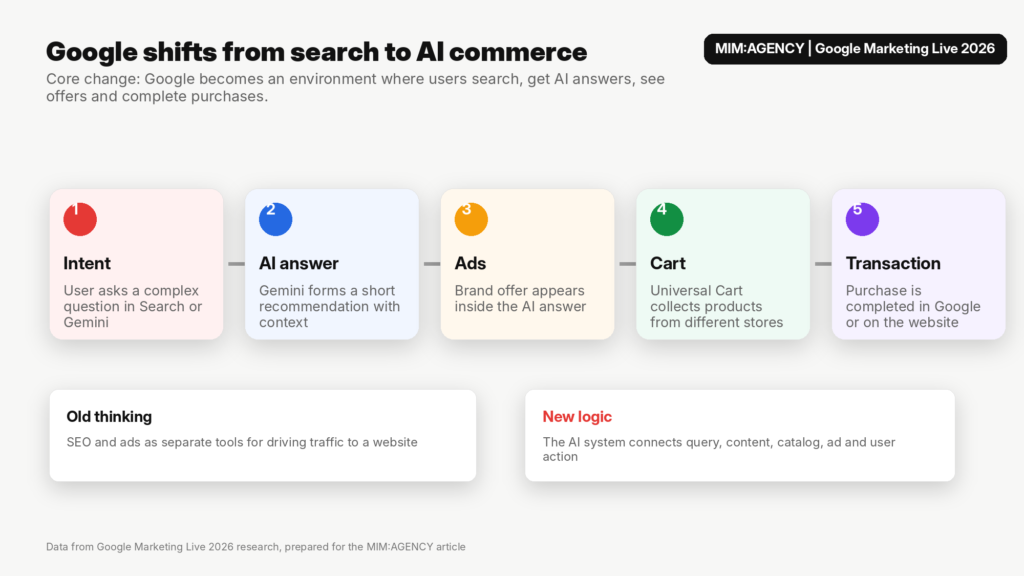
Literally just one day before the conference, Google quietly launched Universal Cart in the U.S. The idea is simple and revolutionary at the same time: users can add products from different stores—Nike, Etsy, Wayfair—to a single shared cart within the Google ecosystem. Via Gemini, YouTube, or Gmail.
The AI doesn’t just save a list of products. It tracks price changes, notifies users when a product is back in stock, and helps complete the purchase—either within Google or by redirecting to the seller’s site without losing the cart.
Previously, Google was an entry point: a person searched for something and went to the store’s website. Now Google wants to be the environment where the entire journey from intent to purchase takes place. This is a fundamental shift in the company’s position in the eCommerce market.
Universal Commerce Protocol: Google Sets the Rules for All AI Commerce
One of the most ambitious announcements of the conference was the Universal Commerce Protocol, an open standard for the interaction of AI agents, stores, marketplaces, and payment systems. Essentially, Google is trying to create a single “language” for AI commerce—so that AI can not only recommend products but also interact with catalogs, check availability, fill shopping carts, process payments, and operate across different platforms without additional integrations.
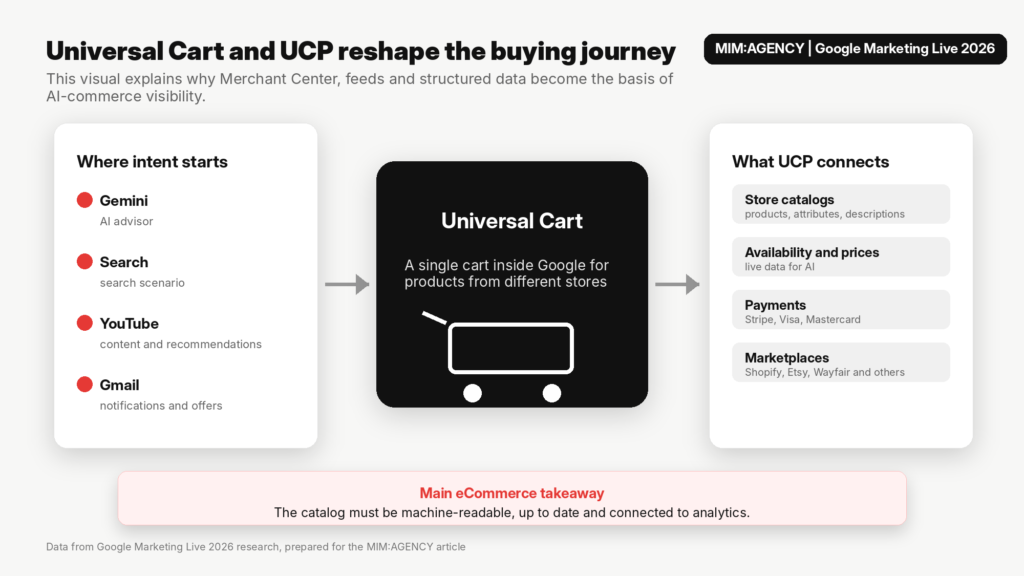
Shopify, Etsy, Wayfair, Walmart, Target, Stripe, Visa, Mastercard, Meta, Microsoft, and even Amazon have already joined the initiative. Google positions itself not as a platform owner but as a neutral player setting the rules. For now, UCP is only available in the U.S., but Canada, Australia, the U.K., and Germany are next in line.
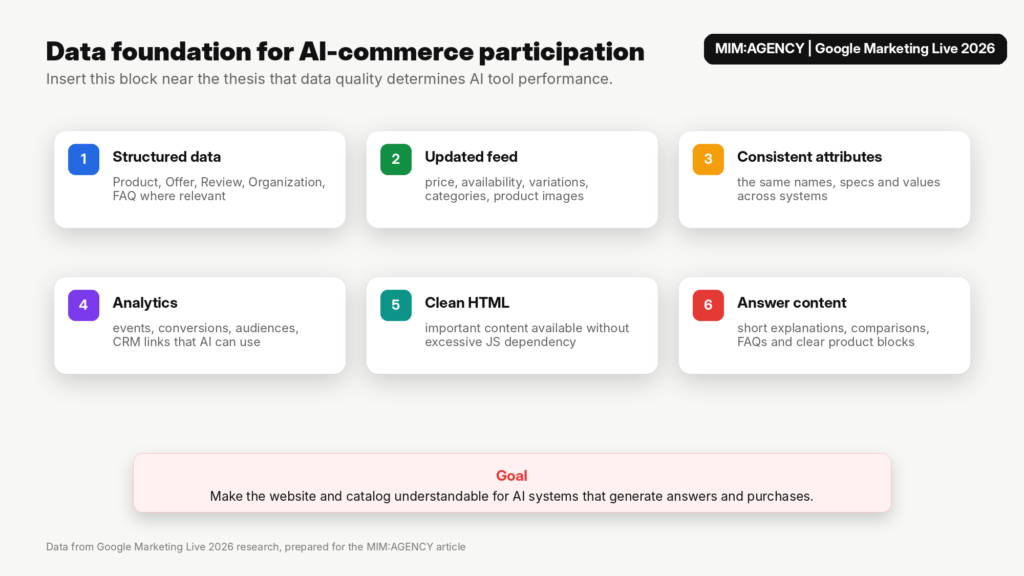
For eCommerce businesses, this is a critical signal: Merchant Center, product feeds, and structured data are no longer just technical details but the foundation of visibility in the AI environment. Those who fail to adapt their catalog to the new logic simply won’t be found.
Ask Advisor: An AI manager instead of dozens of reports
Google has introduced Ask Advisor—a cross-platform AI agent that works simultaneously across Google Ads, Analytics, Merchant Center, and the Google Marketing Platform. Marketers no longer have to open dozens of reports or manually search for patterns in the data. Instead, they ask questions in natural language: why is the performance of a certain category dropping, how should the budget be reallocated for the next quarter. The system analyzes data from all products on its own and offers solutions.
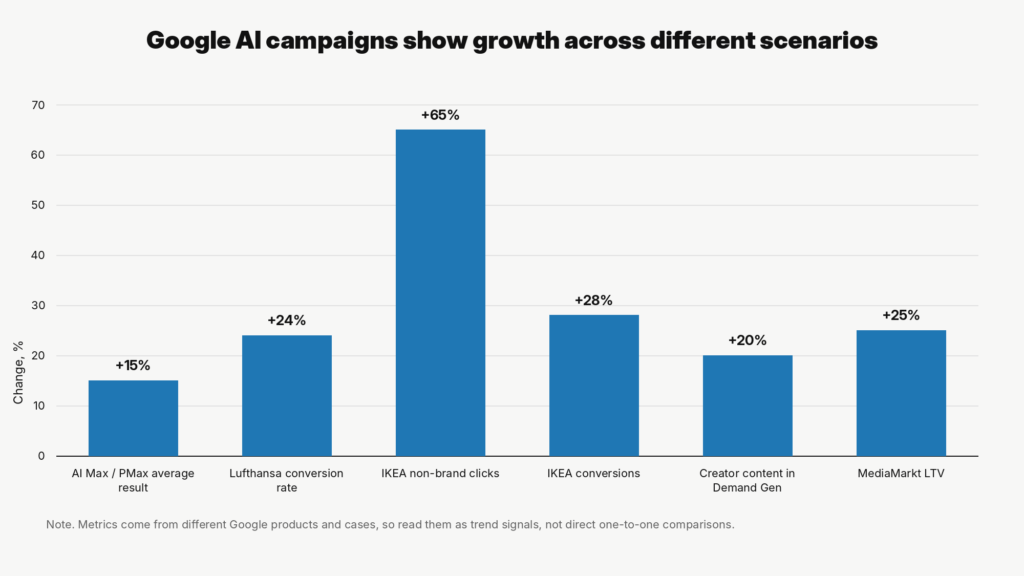
The figures Google cites are impressive: AI campaigns based on AI Max and Performance Max deliver an average of +15% in conversions at similar costs. After switching to AI Max, the Lufthansa Group saw a 24% increase in conversion rate. IKEA saw a 65% increase in clicks from non-branded searches and a 28% increase in additional conversions.
But there is an important caveat that Google emphasizes separately: AI performance directly depends on data quality. Without a strong data foundation, no AI tool can operate at full capacity. This means that investing in analytics and first-party data is no longer an option but a prerequisite for competitiveness.
YouTube Enters the Performance Marketing Arena
Google has dedicated a significant section to YouTube—and this is no longer just about reach or branding. The company is explicitly positioning the platform as an alternative to TikTok, Instagram, and Meta specifically for performance results.
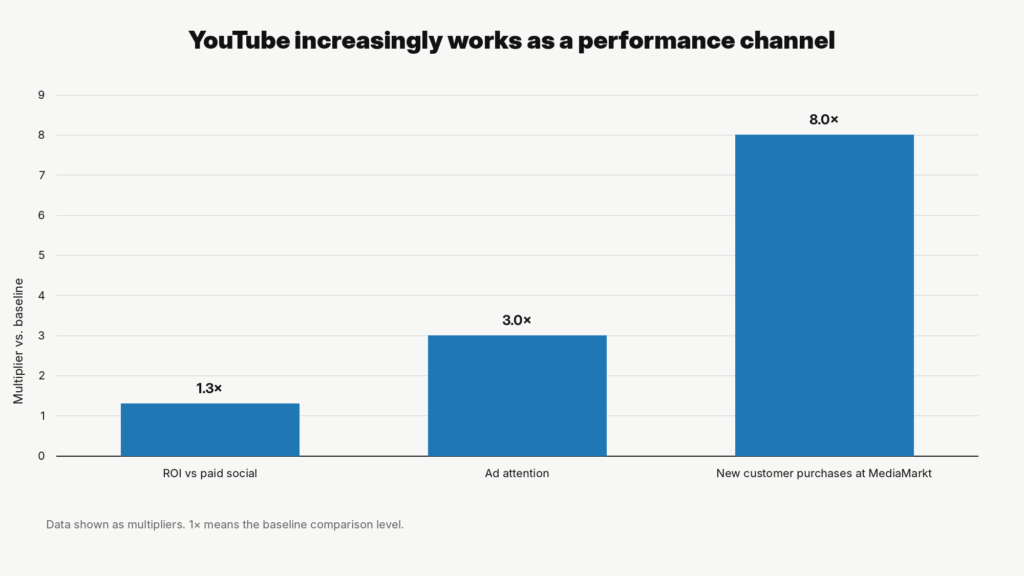
The data for the European market speaks for itself: YouTube’s ROI is on average 1.3 times higher than paid social, and ads on the platform receive three times more user attention. In Germany, 55% of the short-form audience does not use TikTok at all, and shoppers demonstrate 40% higher purchase intent compared to TikTok and 85% higher compared to Instagram.
Google has also introduced a new metric, Engaged Views—now it’s not just the fact that an ad was viewed that’s being measured, but actual engagement and memorability. Demand Gen is also being actively promoted as an alternative to traditional social media advertising: according to Nielsen, combining Demand Gen with Search and Performance Max significantly increases the number of conversions that wouldn’t have been achieved through search ads alone. And using content from creators in such campaigns can further boost conversions by another 20%.
A telling case study: After switching from social media ads to Demand Gen, MediaMarkt saw eight times more purchases from new customers and a 25% increase in LTV.
AI is changing the creative market—but not in the way you might think
Google is integrating Gemini Omni, VO for video generation, and Nano Banana for images into Asset Studio. Pomeli is a new tool that can generate ad scripts, visuals, and videos literally from a website URL. A/B testing of new AI-generated materials against the most effective current assets—in one click.
The routine production of banners, adaptations, and SKU content is rapidly becoming cheaper. But it’s important not to jump to the wrong conclusion here.
AI isn’t killing creativity—it’s killing mediocre, cookie-cutter creativity. The value of something entirely different is rising: strategic positioning, a strong idea, cultural context, and the ability to create communication that doesn’t look like yet another AI template. This is precisely what is becoming a scarce and expensive resource.
What all of this means for Ukrainian businesses—and what to do right now
Google is currently launching most of its new AI features in the U.S. Scaling to Europe will take a few more years. But a key change has already taken place—and it concerns not geography, but logic.
Companies that wait until these tools officially appear on the Ukrainian market will already be too late. Those who are preparing now are building an advantage.
Here’s what you should be doing today:
- Get your Merchant Center and product feeds in order—this is the foundation of visibility in AI search.
- Invest in first-party data and the quality of your analytics—without this, no AI tool works effectively.
- Reevaluate YouTube’s role in your media mix—the platform is already delivering performance results that are hard to ignore.
- Rethink your approach to creative—not “faster and cheaper,” but “smarter and with character.”
- Keep an eye on how AI-powered ad formats are appearing in search—and adapt your content strategy to the new logic.
The MIM:AGENCY team is already adapting its approaches to campaigns, catalogs, and analytics—so our clients aren’t just keeping up with the market, but staying one step ahead.
Sources:
Google Marketing Live 2026: Key Changes in Advertising and eCommerce in the AI Era
