
How AI, Automation, and New Workflows Are Changing the Labor Market and Business in 2026
By 2030, AI will transform 22% of the world’s jobs. The MIM:AGENCY team has compiled data from McKinsey, the WEF, the ILO, and the IMF to show what this means for businesses, industries, and marketing today.

The MIM:AGENCY team collected and analyzed data from McKinsey, Microsoft, the IFR, the OECD, the ILO, the IMF, the WEF, BCG, and other sources to understand where the labor market and business are actually headed under the influence of AI – and what this means for brands building their marketing strategies in 2026.
Companies are no longer just “trying out AI” – they are restructuring their workflows, teams, KPIs, and service economics around it. McKinsey notes a gap between investment levels and the actual maturity of AI implementation; Microsoft highlights the shift toward “humans + agents” teams; the IFR points to the acceleration of robotization in manufacturing and service operations; and the OECD and ILO observe simultaneous growth in productivity, inequality in access to benefits, and pressure on certain roles – particularly entry-level and clerical positions.
Strategy, integration, quality control, brand differentiation, and the ability to link AI to business results will become more valuable.
Key Takeaways on AI in 2026
In 2026, AI will transition from being a set of tools to an operational model: businesses will automate not just individual tasks but entire workflows, and some teams are already designing how humans will interact with agents and robotic systems. A massive collapse in employment is not yet in sight, but there are already clear signs of a shift in demand: AI literacy, data skills, workflow design, human oversight, brand strategy, and cross-functional coordination are increasingly valued, while routine cognitive and administrative tasks are rapidly becoming less valuable.
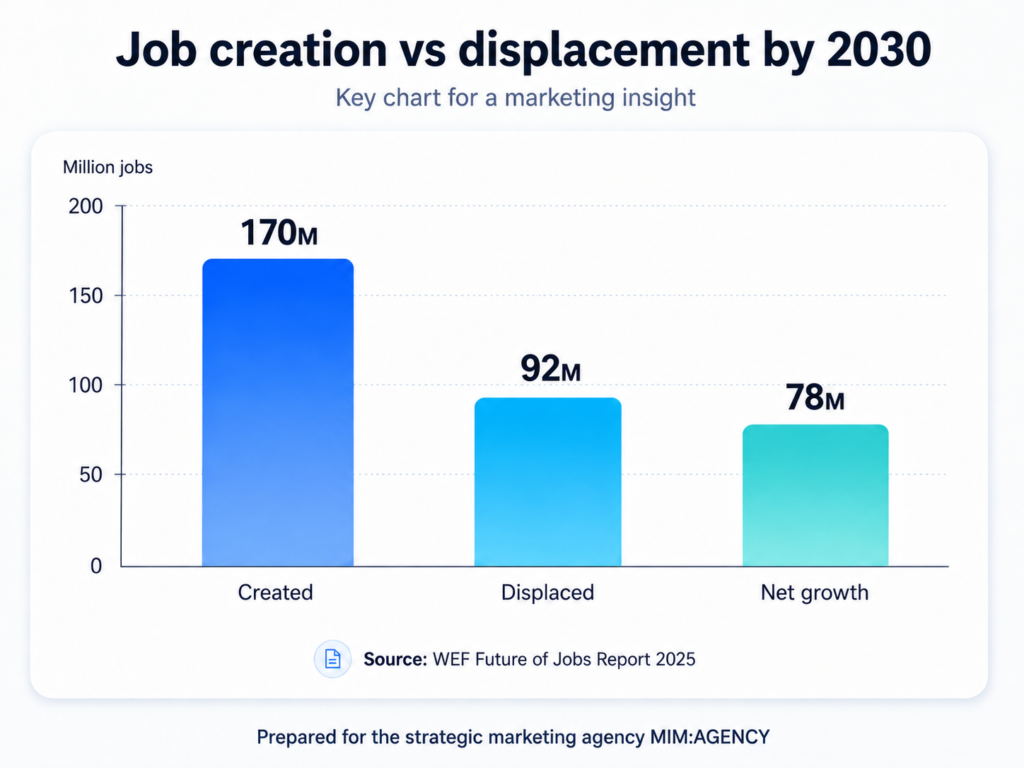
For the labor market, this does not mean “the end of work,” but rather a large-scale reshaping of roles: The WEF estimates that by 2030, 22% of jobs globally will be transformed – 170 million new roles and 92 million displaced – while BCG expects that in the U.S., 50–55% of jobs will be significantly altered by AI within the next two to three years.
For agencies and marketing teams, this creates a window of opportunity: the winners will be those who can sell not production hours, but the speed of decision-making, the quality of orchestration, secure implementation, and a measurable impact on revenue, margin, CAC, ROAS, and cycle time.
The practical takeaway is this: in 2026–2027, agencies should build standalone products centered on AI readiness, AI visibility in search, the content supply chain, marketing operations automation, first-party data, AI governance, and AI literacy. If these areas aren’t formalized now, the market will turn them into an “invisible free option,” which will hurt margins.
Key Trends for 2026
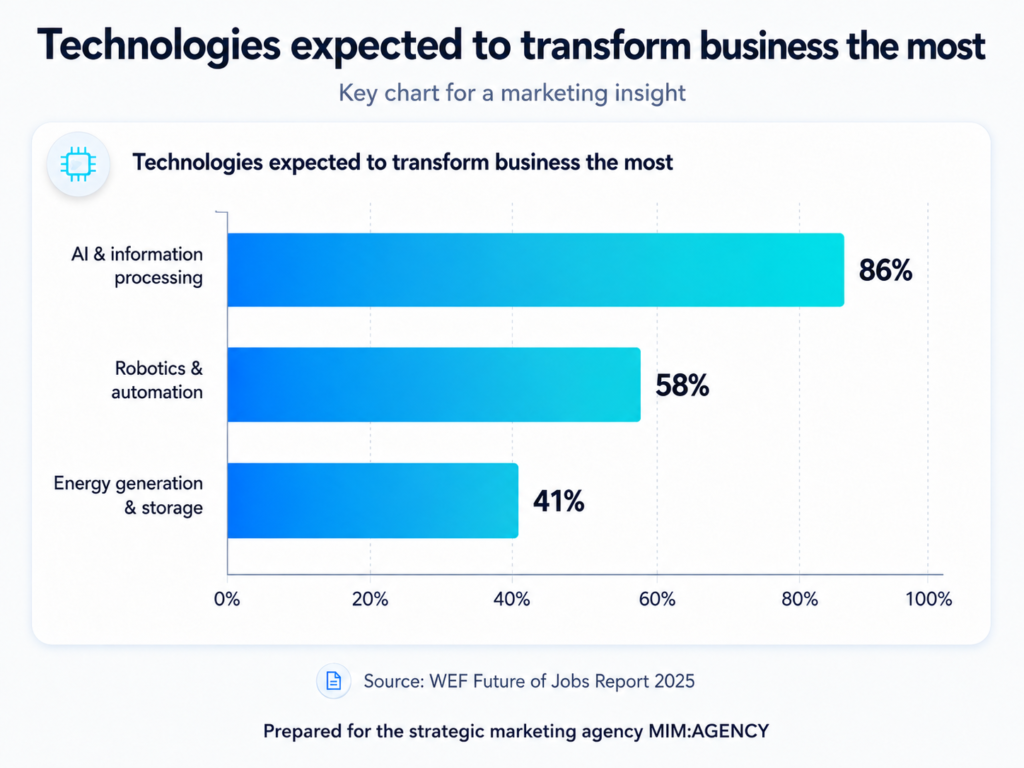
According to the WEF, 86% of employers expect AI and information processing technologies to significantly transform business by 2030. For robotization and automation, this figure stands at 58%; for energy generation and storage technologies, it is 41%.
AI has become a basic infrastructure rather than a differentiator
HubSpot frames this as a shift from the question “who uses AI” to “who operationalizes it better”: 80% of marketers already use AI for content creation, 75% for media production, and 61% believe that marketing is undergoing its greatest disruption in 20 years due to AI. McKinsey adds that 92% of companies plan to increase their AI investments over the next three years, but only 1% of leaders describe their companies as “mature” in terms of fully integrating AI into their workflows and achieving tangible business results.
The second wave – agent-based and workflow-first models
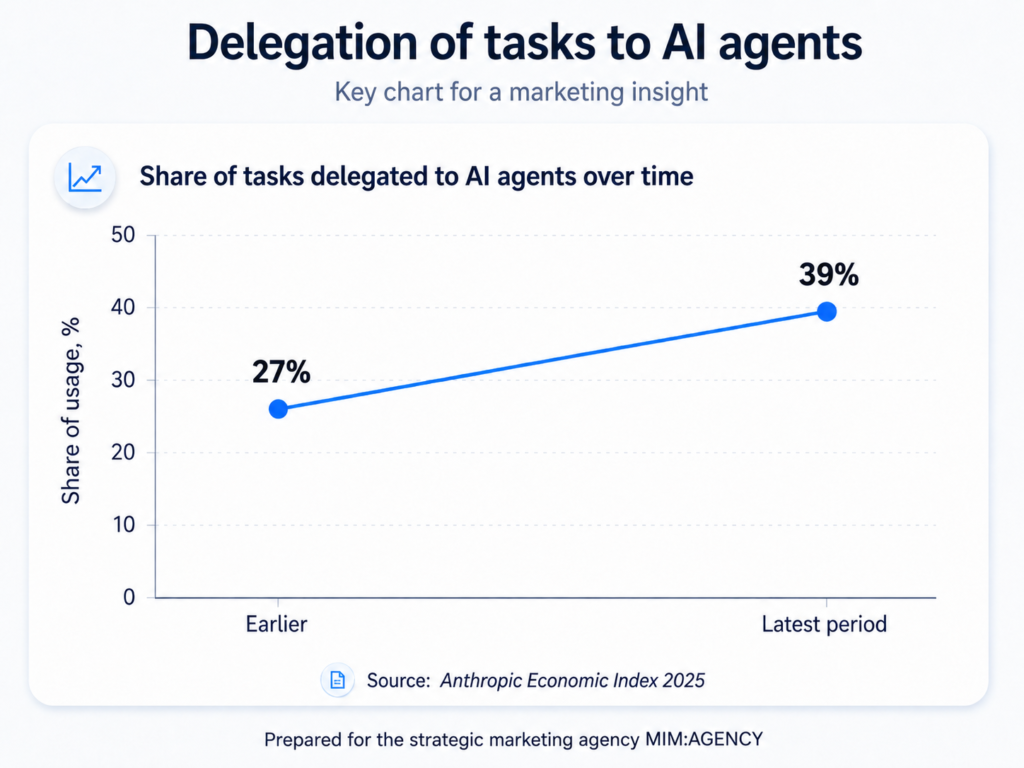
In its Work Trend Index 2025–2026, Microsoft describes a shift toward organizations where AI and agents take over execution, while humans shift toward decision-making, exception handling, and redesigning work. Already, 28% of managers are considering hiring AI workforce managers, 32% are looking to hire AI agent specialists, and over the next five years, leaders expect to restructure business processes for AI, train agents, and build multi-agent systems for complex tasks.
The third trend: robotization is expanding beyond large factories
According to the IFR, 542,000 industrial robots were installed worldwide in 2024, with growth expected to reach 575,000 in 2025; professional service robots increased by 9% to over 199,000 units. South Korea maintains its global leadership with 1,220 robots per 10,000 manufacturing workers, compared to 307 in the U.S. and 267 in Western Europe.
Fourth trend: the consolidation of hybrid work
The OECD notes that remote work has become a permanent feature of the labor market: where possible, two to three days of remote work per week are the norm. This places demands not only on HR but also on digital processes, knowledge management, and the standardization of collaboration.
The fifth trend: demand is shifting from purely technical AI skills to a combination of skills
In June 2026, the OECD states that less than 1% of workers require advanced AI skills; the majority need general digital skills, data handling, and human competencies – digital fluency, data interpretation, creativity, managerial skills, and human oversight.
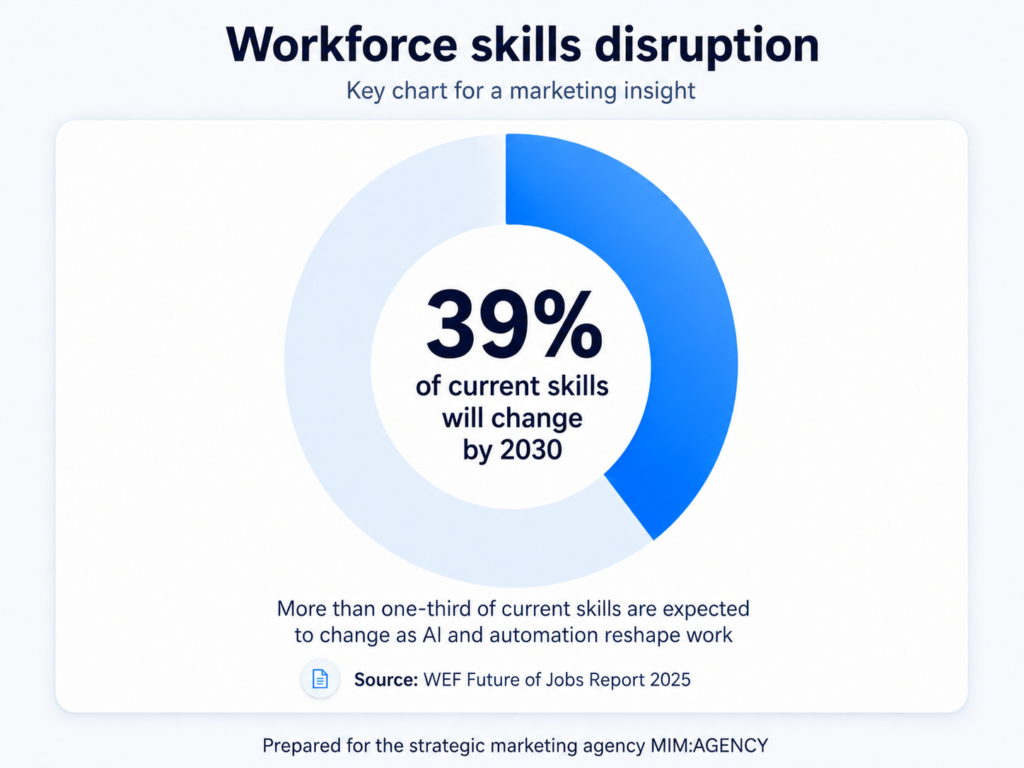
According to a WEF forecast, by 2030, 39% of workers’ current skills will change or become partially obsolete.
The sixth trend is that regulation and ethics are becoming part of operational design
The EU AI Act entered into force on August 1, 2024; requirements regarding AI literacy and prohibitions take effect on February 2, 2025, rules for GPAI on August 2, 2025, and most provisions become fully applicable on August 2, 2026. The Commission explicitly requires providers and deployers to ensure a “sufficient level of AI literacy” among their staff.
The Labor Market in 2026
AI has a greater impact not on the overall amount of work, but on the nature of tasks within roles, the speed of entry into the profession, wage dispersion, and the geography of opportunities.
- The ILO estimates that 25% of global employment is already in occupations potentially vulnerable to GenAI; in high-income countries, the figure is 34%. The highest level of vulnerability is found in clerical roles; female employment in high-income countries is nearly three times more likely to fall into the highest-risk zone for automation (9.6% versus 3.5% for men). The ILO emphasizes that this primarily involves a transformation of tasks, rather than the complete disappearance of professions.
- The IMF estimates that nearly 40% of jobs worldwide are exposed to AI, but the distribution is uneven – about 60% in developed economies, 40% in emerging markets, and 26% in low-income countries. Young professionals are at particular risk: employment in AI-vulnerable occupations will be 3.6% lower in five years in regions with high demand for AI skills.
- The OECD does not yet see a significant negative impact of AI on overall employment in OECD countries, but notes that the benefits are concentrated among high-income and highly skilled workers.
- BCG: Over the next two to three years, 50–55% of jobs in the U.S. will be reshaped by AI; full replacement will take time – in five years and beyond, 10–15% of jobs may disappear.
- The WEF forecasts a global net increase of 78 million jobs by 2030, but this will result from significant churn rather than a smooth trajectory.
An early and most telling sign of this restructuring is vacancy data: a World Bank study of 285 million job openings in the U.S. showed that postings for occupations highly vulnerable to AI replacement fell by 12% relative to less vulnerable ones – an effect that grew from 6% in the first year to 18% in the third. The greatest losses are in entry-level roles requiring no experience and in administrative support positions.
Geographically, AI is intensifying the concentration of opportunities in large, knowledge-intensive economies: average exposure to GenAI stands at 32% in urban regions versus 21% in rural areas, and the gap between specific regions ranges from 45% (Stockholm, Prague) to 13% (rural Kauki). For Ukraine, this means that the greatest demand will continue to be concentrated in large cities and companies focused on digital, data, commerce, and exports.
The Ukrainian market (indicatively, according to job boards): on Work.ua – 59 job openings for “AI engineer,” with an average remote salary of 42,500 UAH. According to DOU’s Winter 2026 Report, median salaries are as follows: Data Scientist – $2,700, AI Engineer – $2,375, ML Engineer – $2,350. AI roles are not yet widespread, but they remain in short supply and relatively expensive, while the main shift in demand is occurring within existing professions.
Changes by Industry
| Industry | Likely role changes | Key skills | Risks | Opportunities |
| IT | Less manual junior-level coding, more code review, architecture, product context, integration, and QA | AI-assisted development, systems thinking, testing, security | Pressure on entry-level talent pipelines, risk of delivery instability without process redesign | Developers using AI complete 26% more tasks, with less-experienced developers benefiting the most |
| Manufacturing | Less reactive maintenance, more predictive maintenance and operator oversight | Equipment data analysis, OT/IT integration, process control | Integration costs, dependence on data quality | Robotics reduces downtime, maintenance costs, and labor shortages |
| Retail | Less routine merchandising, more personalization and inventory intelligence | First-party data, recommendation design, retail media | Over-automation, erosion of trust, privacy risks | Agentic shopping, in-cart assistants, faster ad creation |
| Marketing | Less time spent on production, greater emphasis on strategy, brand point of view, and orchestration | Prompting, brand systems, analytics, experimentation | Content commoditization, declining value of manual production | 80% of marketers already use AI for content, while speed and trustworthy execution create a competitive advantage |
| Finance | Less manual first-line support, more exception management and compliance oversight | AI governance, compliance, risk review | Bias, regulatory exposure, reputational risks | Faster multilingual customer support at scale |
| Logistics | More AI-assisted routing, forecasting, and exception handling | Demand forecasting, warehouse automation | Integration complexity, operational safety | AI-powered robots already increase sorting capacity by more than 40% in express logistics |
What this means for agencies and marketing
In 2026, two parallel markets will coexist for agencies:
- Production market – AI is rapidly driving down the cost of writing text variations, resizing creatives, first drafts, translations, and routine analytics.
- Strategy & orchestration market – prices here are rising because clients need secure integration of AI into their brand systems, performance funnels, first-party data, search visibility, measurement, and governance.
It is in this second market that agency margins can remain healthy. HubSpot states explicitly: “AI is the baseline, not the differentiator.” Adobe notes that 86% of marketing leaders expect significant growth in speed and volume, while banking on “human-centered AI”; HubSpot itself prioritizes brand perspective, trust, and human-led marketing by 2026.
A telling example of operational impact is the Reckitt case: Microsoft reports up to 60% faster concept development and up to a 90% reduction in time spent on daily marketing tasks. But McKinsey warns: nearly everyone is investing in AI, and only 1% has actually integrated it into their workflow to the extent needed to achieve significant business results. Value is created not by the tool itself, but by restructuring the content supply chain, review loops, QA, data flows, and decision-making authority.
Key risks for agencies:
- Price compression – selling the same output sooner or later leads to demands for lower fees.
- Trust risk – concerns regarding cybersecurity, inaccuracies, privacy, IP, and compliance; without process redesign, AI may boost individual productivity but impair team throughput and stability.
- Governance gap – AI literacy obligations are already in effect in the EU, and requirements for transparency and human oversight are becoming standard procurement practices for B2B clients.
Practical takeaway on pricing: It makes sense for agencies to transition from predominantly task/hour pricing to a hybrid model – a strategic retainer + implementation fee + performance-linked component. Production costs are falling, while value is shifting toward strategy, governance, analytics, experimentation, and the integrated outcome. Without this, AI will simply eat up billable hours.
What This Means for Brands and Businesses
- Campaigns, creative variations, insights, and operational reporting will emerge faster, but speed without a data system and human QA does not guarantee results.
- The winner won’t be the brand that “just uses AI,” but the one that combines AI with a clear brand perspective, trust, and a high-quality first-party data architecture.
- It’s becoming increasingly important to be visible not only in traditional search but also in AI-mediated discovery and recommendation environments – this applies to content, feeds, product data, and knowledge assets.
- Marketing procurement is shifting from “how much you produce” to “how much you reduce cycle time, improve decision quality, lower CAC, or accelerate the impact on revenue.”
- For EU-facing businesses, AI literacy, transparency in AI usage, and vendor due diligence are becoming part of the standard procurement checklist.
Our Approach at MIM:AGENCY
We are convinced that the right position for an agency in 2026 is not “an agency that uses AI,” but “an agency that knows how to turn AI into a measurable business impact without sacrificing quality, control, or brand integrity”. This is a product-centric, not a tool-centric, approach, and this is exactly how we structure our work with clients.
What this means in practice:
- AI Readiness Audit – a standalone product for clients: an assessment of data readiness, content operations, use cases, legal risk, brand safety, and measurement gaps. This is a paid initial phase prior to automation, not a free consultation.
- AI Visibility & GEO – working on brand presence in AI answers, shopping assistants, and recommendation layers: site structure, schema, product feeds, source hygiene, editorial authority, and FAQ/knowledge assets.
- Content Supply Chain – content services as a cycle: briefing → idea generation → draft production → approval → localization → activation → measurement. This is where AI creates value, rather than simply acting as a “cheaper copywriter.”
- Marketing Ops Automation – AI-assisted research, reporting, CRM handoff, scorecards, meeting summaries, proposal generation, creative variation pipelines, QA checklists.
- AI Governance as a Service – policy kits for EU clients or those with enterprise procedures: list of approved tools, prompt/data policy, human review rules, disclosure rules, vendor due diligence, incident logging, AI literacy plans.
- Focus on measuring impact – in proposals and contracts, we focus on cycle time, lead quality, conversion rates, cost-to-serve, content reuse, and branded search lift – rather than on the number of deliverables.
- In-house AI academy organized by role – separate tracks for account managers, strategists, PPC specialists, SEO/GEO specialists, content specialists, designers, analysts, operations specialists, and leadership.
- Human-in-the-loop as part of the brand promise – especially for high-value B2B, finance, healthcare, legal-adjacent, and multilingual workstreams.
- Partnerships with martech, cloud, and legal expertise – we deliberately build a platform + governance + execution framework, rather than relying on individual freelancers with a prompt library.
Scenarios and Forecasts for 2026–2029
This is not a prophecy, but a working scenario framework based on the WEF, BCG, McKinsey, Microsoft, OECD, ILO, IMF, and IFR. The common logic: what lies ahead is not a single linear trajectory, but a combination of accelerating automation, the growth of agent-driven workflows, uneven skill adaptation, and regulatory tightening.
Optimistic Scenario
By 2029, businesses will have transitioned from “tool adoption” to workflow redesign: 20–35% of internal marketing operations will be automated without a loss of quality, and new AI-enabled services will account for a significant share of new revenue. People transition into high-value roles faster than older roles are eliminated – this aligns with Microsoft’s “agency expansion” logic, BCG’s augmentation logic, and the WEF’s picture of net growth.
Base Case (Most Likely)
Production work is becoming cheaper and faster, but profits remain in strategy, analytics, first-party data, AI visibility, governance, and complex campaign orchestration. The labor market is generally stable, but entry-level white-collar positions are shrinking, and wage growth is concentrated among high-skill workers and urban knowledge hubs. Without a product-focused restructuring, agency margins decline; with restructuring, average check size and client retention increase.
Pessimistic Scenario
Companies are buying AI tools en masse without redesigning their processes; the market is flooded with low-quality content; clients are losing trust; regulatory and vendor risks are rising; and budget pressures are reducing agencies to the role of “cheap production layers.” For the labor market, this means greater pressure on junior and clerical roles, greater salary polarization, and slower creation of high-value jobs. This is precisely the scenario warned against by McKinsey (the investment/maturity gap) and DORA (deterioration of delivery outcomes without process discipline).
Practical Conclusion for 2026–2029
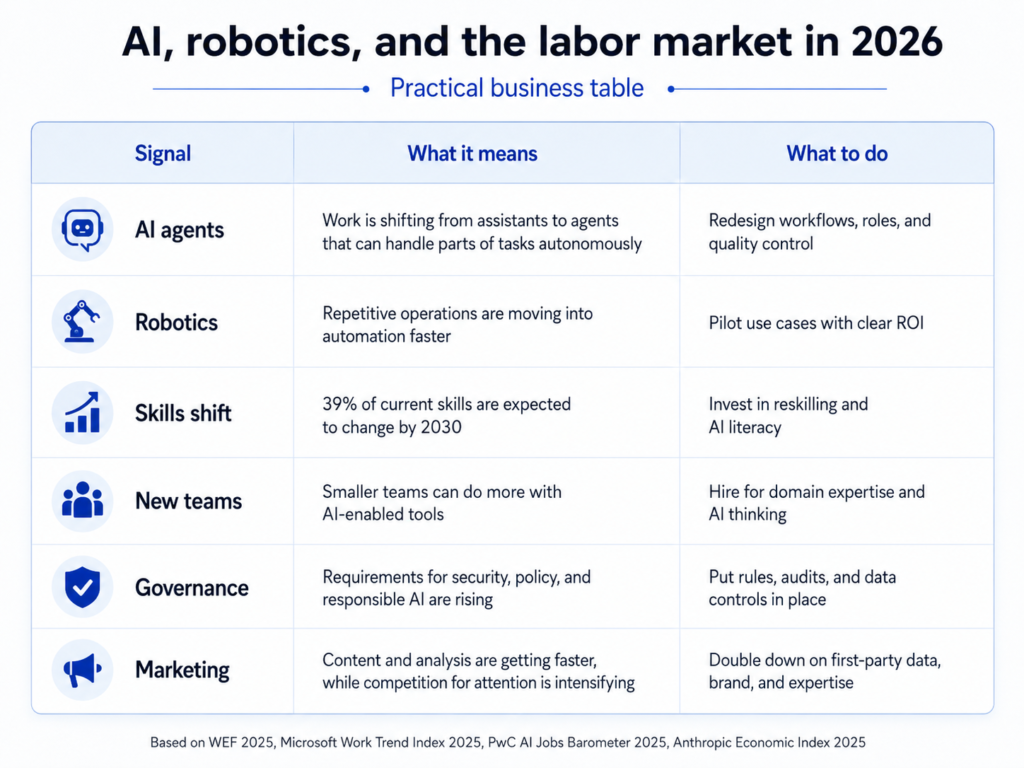
Don’t plan for the future around “more AI-generated content.” A wiser bet is on AI-enabled go-to-market systems: data readiness, faster insight cycles, content operations, search visibility in AI environments, more secure governance, and measurable business impact. It is precisely these categories that fare best under both the optimistic and baseline scenarios.
