
EGC: Employee-Generated Content as the New Currency of Trust
Research shows employee-generated content converts 7x more often than traditional leads, at a fraction of paid media cost. MIM:AGENCY breaks down why EGC has become the new currency of trust, and how to build the channel the right way.

The content market has come full circle. At first, brands invested in their own channels; then, in UGC from customers; now, the pendulum has swung even further: the content that converts best turns out to be the kind that no one specifically commissioned – posts, videos, and comments from the company’s own employees. MIM:AGENCY has figured out why employee-generated content has ceased to be a side effect of corporate culture and has become a separate marketing channel with a measurable impact on trust, conversion, and customer acquisition cost.
What Is EGC and How Does It Differ from UGC
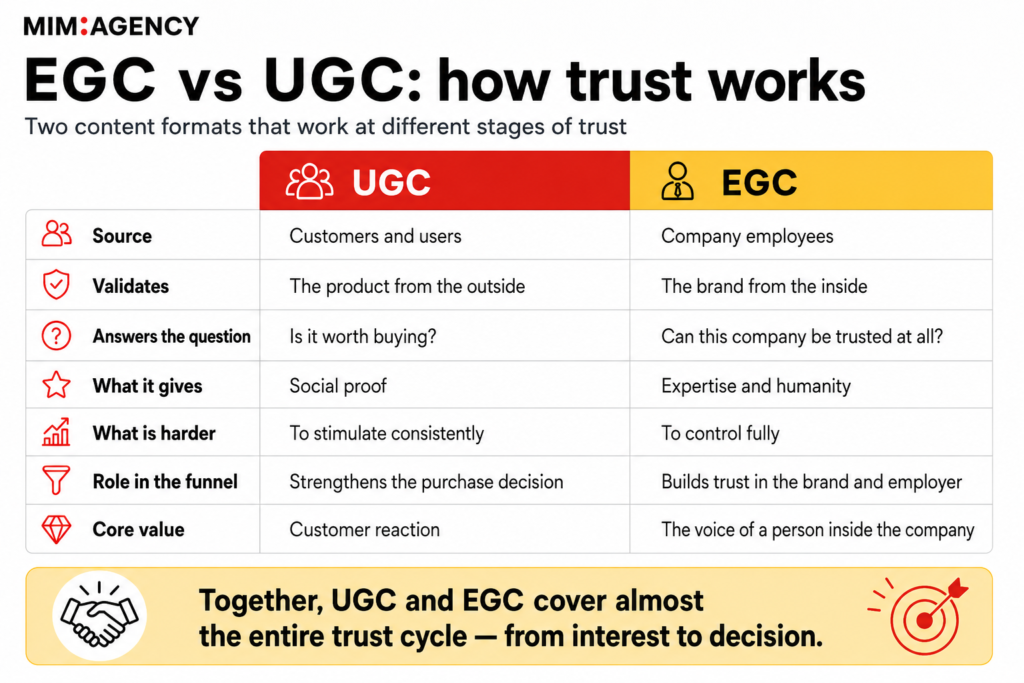
User-generated content (UGC) validates the product from the outside – it consists of reviews, unboxing videos, and customer posts. Employee-generated content (EGC) validates the brand from the inside – it’s how real employees talk about the company, a project, the industry, or their workday, without a script from the marketing department. UGC answers the question “Is this worth buying?” while EGC answers another question – “Can this company be trusted at all?” Together, they cover almost the entire trust cycle, but on its own, EGC has long been underappreciated because it’s harder to control and nearly impossible to fully stage – and that’s precisely where its value lies.
Why Is This Happening Right Now
Three processes have converged. First, the audience has become noticeably more skeptical of polished brand content – people intuitively recognize when a post is written by the marketing department rather than by a real person. Second, organic reach for brand pages continues to decline, while personal profiles perform better algorithmically. Third, the cost of paid traffic remains high, and companies are looking for channels that don’t depend directly on their advertising budget.
The situation is further exacerbated by the fact that trust in employers and business leaders has declined significantly in recent years – and it is against this backdrop that the voice of a specific person within a company begins to carry more weight than the brand’s voice.
What the Numbers Show
Here, EGC ceases to be a matter of perception and becomes a matter of data.
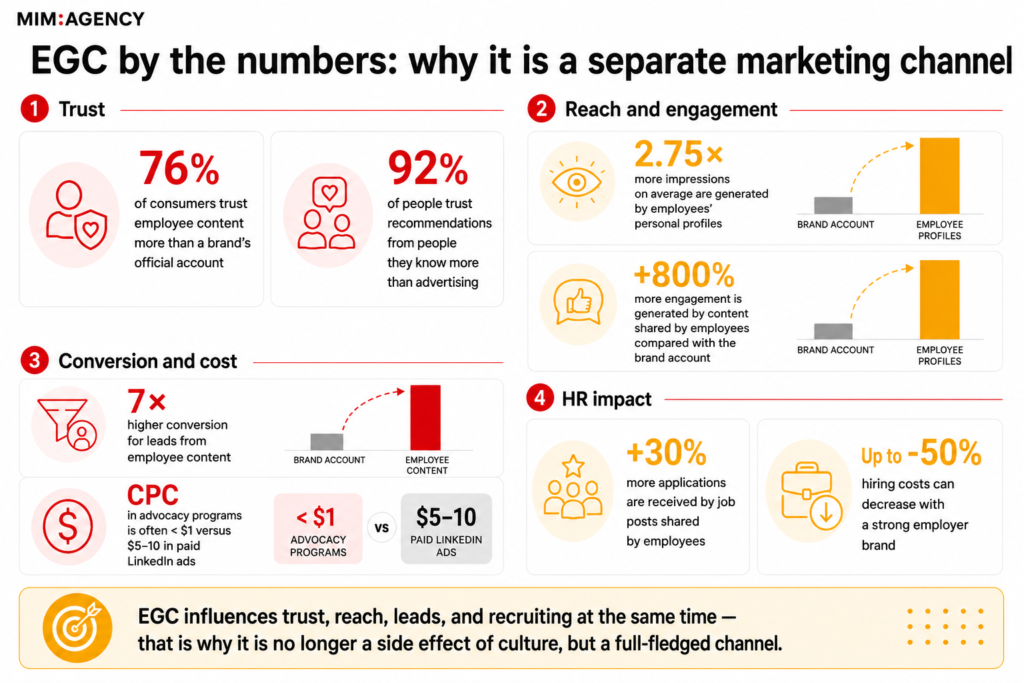
Trust. According to Edelman, 76% of consumers trust content shared by employees more than content from a brand’s official account. Nielsen confirms this logic with other figures: 92% of people trust recommendations from people they know personally more than any form of advertising.
Reach and engagement. Employees’ personal profiles generate, on average, 2.75 times more impressions than a company page, and content shared by employees receives 800% more engagement compared to the same content on a brand account. This isn’t because employees write “better” in a marketing sense – social media algorithms systematically prioritize personal profiles over business pages.
Conversion. According to IBM, leads generated through content shared by employees convert 7 times more often than leads from other sources. For B2B, where the sales cycle is long and decisions are made by more than one person, this is one of the most striking figures in this entire topic.
Cost per acquisition. In employee advocacy programs on LinkedIn, the reported cost per click is most often less than $1 – compared to $5-10 for paid advertising on the same platform. Leading programs achieve an equivalent media value 3-5 times higher than the cost of the process itself within 6-12 months of full rollout.
Recruiting as a side effect. Job postings shared by employees receive 30% more responses, and a strong employer brand can reduce hiring costs by 50%. EGC functions not only as a marketing channel but also as an HR channel – the line between these two functions practically disappears in this context.
How EGC Differs from “Simply Asking Employees to Post”
The main mistake companies make is trying to manage EGC the same way they manage branded content: writing scripts, approving wording, and demanding a “consistent tone of voice.” At that point, EGC ceases to be EGC. Market research from 2026 shows that most active brand advocates share original content they’ve created themselves, rather than materials prepared by the company – and it is precisely this originality that is the source of trust, which cannot be replicated by a script.
This creates a challenging but important shift in the brand’s role: instead of writing content for employees, the company creates an environment where they have something to say and feel comfortable saying it. This means providing context (industry insights, data that can be used to comment on issues) rather than ready-made posts to copy.
Risks to Consider
EGC isn’t risk-free, and it would be dishonest to ignore that.
Loss of control over the message. When an employee speaks in the first person, the company cannot pre-approve every word. The solution here isn’t strict control, but clear – yet not stifling – guidelines: what can and cannot be disclosed, rather than how exactly to phrase sentences.
Inconsistent quality. Not every employee is a natural communicator, and that’s normal. An EGC program works not because everyone speaks equally well, but because enough people speak often enough for the cumulative effect to outweigh individual weak posts.
Advocates’ burnout. If participating in the program is perceived as an additional workload without recognition, enthusiasm quickly fades. Sustainable programs are built on voluntarism and visible recognition of contributions, not on KPIs tied to the number of posts.
Confusing EGC with AI-generated content masquerading as personal opinion. The quickest way to destroy the trust that EGC builds is to automatically generate “personal” posts for employees using AI and publish them on their behalf without any real human involvement. At that point, authorship becomes a fiction, and the audience will sense it sooner or later.
How to Build EGC as a Channel, Not a One-Time Initiative
Start with context, not with a requirement to post. Give the team material they can discuss from a professional standpoint – data, insights, access to expertise – rather than a ready-made text.
Identify 25–50 engaged individuals instead of requiring participation from the entire company. The program doesn’t require 100% staff coverage – the quality of participation from a few dozen engaged people is more important than the formal participation of everyone.
Provide an easy way to share, not a complicated approval process. The more approval steps there are, the less organic the result will be – and the less sense the idea of EGC itself makes.
Track results end-to-end. UTM tags on everything employees share allow you to see actual traffic and leads, not just impressions and likes – without this, the program remains a “cultural” initiative rather than one focused on marketing results.
Publicly acknowledge contributions. People continue to share not for the sake of company metrics, but because they feel it means something to them personally.
Key Takeaway
EGC works not because it’s a new content format – it’s a new type of currency that can’t be bought directly. An advertising budget scales reach, but it doesn’t scale trust: trust is built by a specific person who speaks on their own behalf and takes a reputational risk in doing so. Brands that understand this before their competitors will gain a channel that doesn’t degrade over time the way paid advertising effectiveness does – but rather grows alongside the reputation of each individual employee.
For marketing teams, this means a shift in priority: investing not only in content about the brand, but in the people who represent that brand every day – whether consciously or not.
