
Cultural Code and Hyper-Personalization: How Not to Cross the Line
71% of consumers expect personalization, yet that same personalization often feels invasive — and the line between the two frequently runs through the audience's cultural context. MIM:AGENCY on how to hyper-personalize without breaking trust.

By 2026, hyper-personalization will no longer be a competitive advantage, but rather a basic expectation of the audience. But that’s precisely why it has also become the greatest risk: the very technology that makes communication relevant can, with just one misstep, make it “creepy” – that’s the word the audience uses most often when personalization stops feeling like care and starts feeling like surveillance.
The MIM:AGENCY team has figured out where this line is drawn and how the audience’s cultural context determines just how far you can go with personalized communication.
The Paradox of Hyper-Personalization in 2026
The data simultaneously confirms two opposing theses, and both are true. On the one hand, according to McKinsey, 71% of consumers expect personalized interactions from brands, while generic, one-size-fits-all messages consistently fail to engage audiences today. On the other hand, that same hyper-personalization is often perceived by the audience as overly intrusive or even “creepy,” even when it is technically accurate.
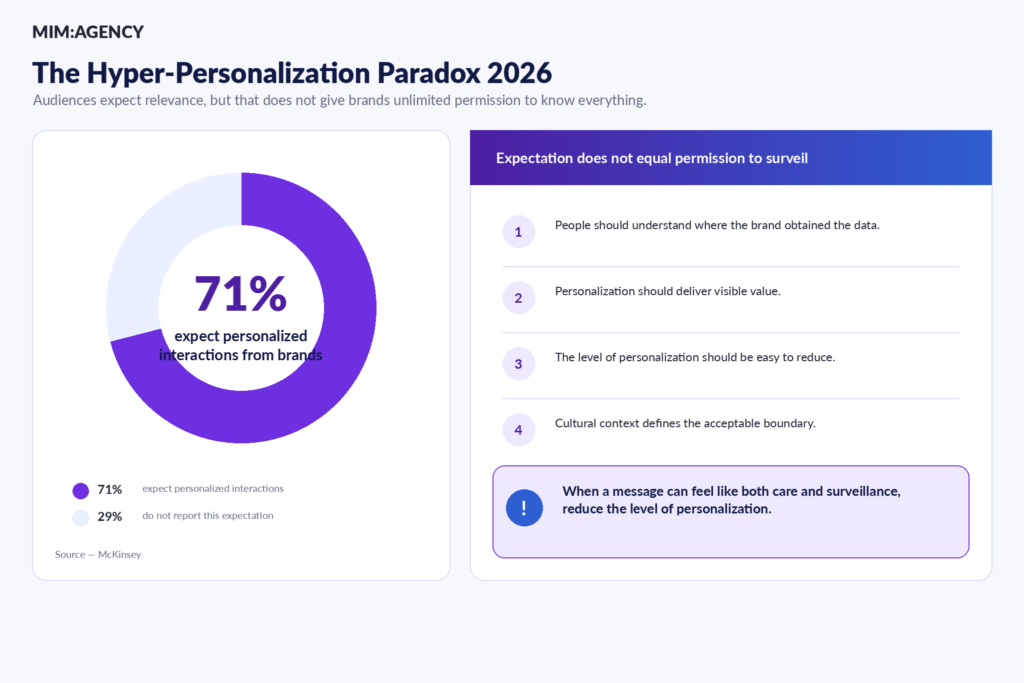
This isn’t a contradiction in the audience’s logic – it’s a matter of boundaries. Even among consumers who consciously protect their privacy, the majority still want a brand to learn from their behavior over time. People aren’t opposed to personalization as a concept – they’re opposed to personalization that feels like control over them rather than a service for them.
Where cultural context comes into play
This is where the practical complexity begins – one that teams working from universal playbooks based on Western markets rarely take into account. Tolerance for personalization is not a universal constant, but a variable deeply rooted in the audience’s cultural context.
Different attitudes toward privacy. In cultures with high power distance and a collectivist orientation, personal data is often perceived as something to be shared only within a trusted circle – a brand that acts as if it has already entered that circle uninvited violates a social norm, not just a technical regulation.
Different levels of tolerance for direct address. A personalized message that is interpreted as friendly concern (“we’re thinking of you”) in one culture may be perceived as intrusiveness or even a lack of respect for the distance a person consciously maintains from a brand in another.
Different expectations regarding who “has the right” to know certain information. In some contexts, mentioning marital status, age, health, or financial situation in an advertisement is a standard targeting practice. In others, it is a direct means of causing offense, even if the data was technically collected with consent.
Linguistic and symbolic context. Automatic personalization that adapts only the name and product but ignores the cultural connotations of color, symbols, and forms of address (“you” instead of “you all,” direct imperatives instead of softened phrasing) creates the impression that the brand speaks the audience’s language technically but does not truly understand it.
For an agency working with clients in different markets simultaneously, this means one thing: a hyper-personalization template that worked in one campaign cannot be automatically applied to another simply because the technical infrastructure allows it.
Principles That Keep Personalization Within the Bounds of Respect
Transparency of value, not just transparency of data collection. A brief, clear privacy notice next to the personalized section reduces the “creepy” feeling and reminds people why this personalization exists in the first place. People don’t need to know the entire technical mechanism – they need to understand what they’re getting in return.
Personalization based on permitted data, not everything that’s technically available. The 2026 trend is moving toward personalization based on zero- and first-party data and transparent value exchange instead of stealthy signal collection. Just because an algorithm can deduce a person’s behavioral pattern doesn’t mean you should show them just how deeply you’ve “figured them out.”
Control lies in the hands of the user, not just in the default settings. The ability to easily reduce the level of personalization or turn it off completely is not a concession but a basic prerequisite for trust, especially in cultural contexts where privacy is highly sensitive.
Cultural adaptation at the level of logic, not just translation. Localizing a hyper-personalized campaign should involve asking not “how should this be translated,” but “is it even appropriate to address people this way in this context?” – this decision is made by a person with an understanding of the culture, not by a language model.
Exercise caution with sensitive data. Health, financial vulnerability, family circumstances, religious or ethnic affiliation – even when targeting is technically accurate and lawful, this is precisely the category of data where “can” and “should” are different questions, and the latter must always take precedence.
How this looks in the team’s day-to-day work
Before launching a personalized campaign in a new market or for a new audience, it’s helpful to ask the team three direct questions:
- Will the person understand how the brand knows what it’s showing or what they know?
- Will they perceive this as care or as surveillance?
- Will this message be equally acceptable in the cultural context of this specific audience, and not just in the context for which the campaign was originally created?
If the answer to any of these questions is ambiguous, the level of personalization should be reduced rather than explained after the fact.
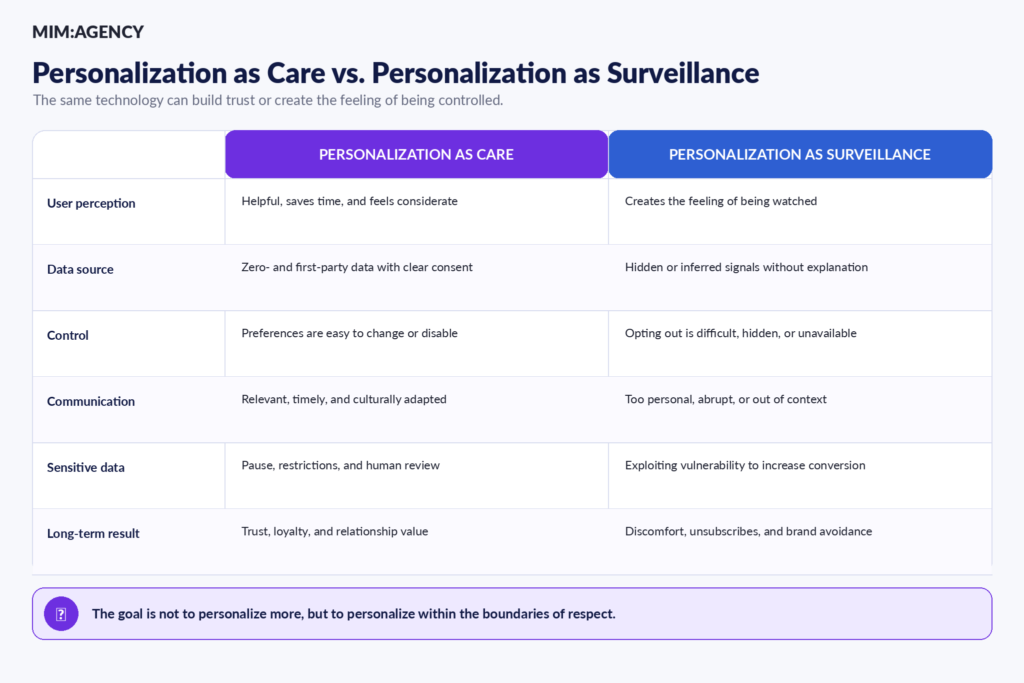
Key Takeaway
Hyper-personalization in 2026 is no longer a question of “can we do this technically?” Technically, almost anything is possible.
The question is: at what point does personalization stop serving people and start serving only campaign metrics? The audience’s cultural code isn’t just an additional layer of localization on top of a ready-made strategy; it’s one of the conditions under which personalization remains personalization at all – rather than turning into its opposite: the feeling that you’ve been reduced to a set of data.
Brands that consciously maintain this balance achieve something no algorithm can create on its own – the trust of their audience, which endures even after a specific campaign has been forgotten.
