
Digital Reputation: How to Measure What Once Seemed Intangible
Brand reputation is no longer scattered across PR, marketing, and HR — it's a single digital currency that can be measured. MIM:AGENCY presents a practical six-metric framework: from mentions and context to EGC, case studies, and public speaking.

Just a few years ago, “brand reputation” was a phrase that appeared in strategic presentations but rarely in tables of metrics. It was discussed but not measured: too vague, too subjective, too dependent on context. In 2026, this situation changed for good. MIM:AGENCY explored why digital reputation has become the sole measurable asset – and which metrics framework allows us to track what seemed elusive just yesterday.
Why Reputation Is No Longer Fragmented
Market observations in recent years have documented the same shift: podcasts, articles, social media, speeches, websites, partner mentions, webinars, and comments under posts – all of this no longer exists as a set of separate activities with distinct KPIs. The audience perceives this as a single digital profile – and processes it faster than a brand can prepare an official presentation about itself. People first interact with a company online and only later, if at all, offline; therefore, no flawless physical presence can compensate for inconsistencies in the digital footprint.
That is precisely why reputation can no longer be measured in fragments – a framework is needed that interprets it as a unified system.
Digital Reputation Metrics Framework
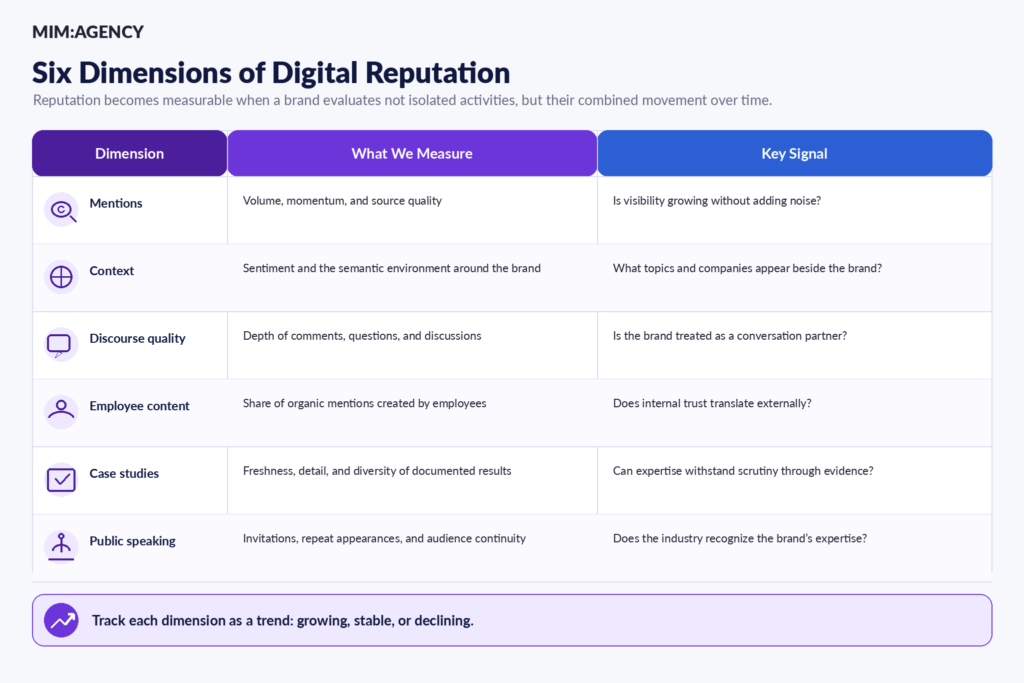
The practical complexity of digital reputation lies in the fact that it is both quantitative and qualitative. Therefore, the framework we use in our work with clients is built on six dimensions – each covers a separate part of the picture, and none operates in isolation from the others.
Mentions. A foundational but insufficient level on its own – the volume and dynamics of brand mentions in the media, on social media, in industry publications, and in comments. It’s important to track not only the volume but also the source: a mention in a specialized publication carries different weight than one in an anonymous Telegram channel. An increase in the number of mentions without monitoring the quality of sources creates a false sense of growing reputation where, in reality, only the noise is increasing.
Context. This is a dimension that is most often overlooked: the environment in which the brand appears. A mention alongside industry leaders, in the context of expertise or innovation, builds reputation. The same mention in the context of a scandal, a controversy, or as an example of “what not to do” – formally, it’s also a “mention,” but with the opposite effect. Therefore, every mention should be categorized by tone and by the semantic field in which it appears.
Quality of discourse. Here, it’s not the mere fact of the brand’s presence in the conversation that’s measured, but the level of that conversation. Are the comments under the brand’s posts a substantive discussion among experts, or are they just casual “likes” without engagement? Does the audience ask questions, or do they ignore the content? The quality of discourse is an indicator of the extent to which the brand is perceived as a conversation partner rather than a source of one-sided messages.
Employee-generated content. The proportion of brand mentions that come from authentic voices within the company – rather than just the official account – is a distinct and increasingly important reputation metric. When the team speaks about the company voluntarily and in their own words, it serves as external validation of the company’s culture – something the brand cannot fabricate on its own. It’s worth tracking both the volume of such content and how organic – rather than scripted – it is.
Case studies. Documented, verified results are the level of reputation that stands up to scrutiny from a skeptical B2B buyer. The metric here isn’t just the number of case studies, but their recency, the diversity of industries they cover, and the depth of detail: a case study with specific figures and mechanics carries significantly more weight than a general description like “we helped a client grow.”
Public appearances. The presence of brand representatives at conferences, panel discussions, podcasts, and educational programs is a measurable indicator of expert recognition by the industry – not just self-promotion. What matters here isn’t the number of appearances, but whether brand representatives are invited back, or whether a loyal audience is forming around a specific individual.
How to Put It All Together
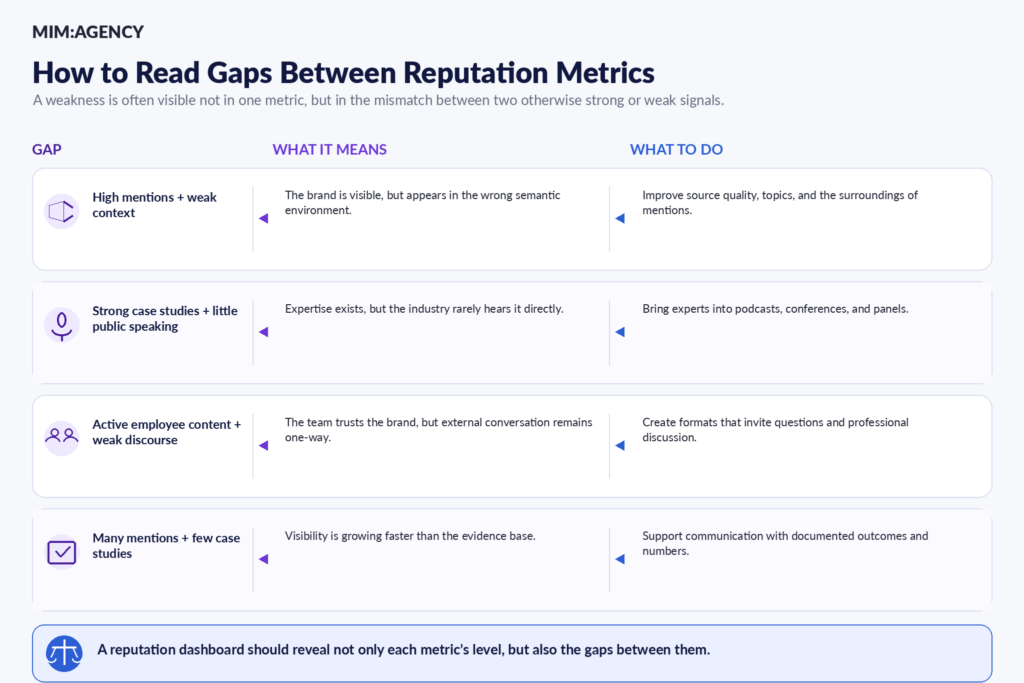
Each metric on its own provides a fragment, but the value of the framework lies in comparing these six indicators with one another. A brand may have a high level of mentions but at the same time low-quality discourse – this signals a presence without real audience engagement. Or, there may be many case studies but almost no EGC – this means that external communication exists, but the team’s internal trust in the brand has not yet been conveyed to the outside world.
In practice, this takes the form of a quarterly dashboard where each of the six metrics is tracked not as an absolute number but as a trend: whether it is growing, stagnating, or declining relative to the previous period. It is the trend, not a one-time snapshot, that shows whether the brand’s reputation is becoming more cohesive over time.
What to Do About Gaps Between Metrics
When one metric lags significantly behind the others, that’s no reason to ignore the rest – on the contrary, it’s precisely the gap that indicates where to focus next. High mentions with a weak context mean that you should focus on the environment in which the brand appears, rather than simply increasing the volume of its presence. Strong case studies without public appearances mean that expertise exists but lacks a voice to represent it directly to the industry.
