
Quality Over Quantity: Why B2B Lead Generation in 2026 Works Completely Differently
Not long ago, B2B lead generation success was measured by the sheer number of leads in the funnel. In 2026, that logic no longer holds: buyers have become more cautious, deal cycles have grown longer, and AI tools now filter out unqualified contacts before they ever reach a sales team. The MIM:AGENCY team examined why lead quality now matters more than lead volume – and what that means for B2B companies.

Just a couple of years ago, the formula seemed simple: more leads – more deals. Website forms, gated content, mass email campaigns, KPIs based on the number of MQLs. The logic was as straight as an arrow: fill the funnel from the top, and sales will sort themselves out at the bottom.
Now this formula is falling apart right before our eyes. And the problem isn’t that the channels have gotten worse – the problem is that the buyer has changed, but the approach to lead generation hasn’t.
The buyer is no longer the same
Today’s B2B buyer researches solutions independently, at length, and anonymously – long before they reach out to you or sign up for a demo. They consume content across multiple channels simultaneously, compare options, form an opinion – and only then make contact.
And when they finally do, they don’t need an introductory presentation explaining “who you are and what you do.” They need confirmation that you understand their industry, their constraints, and their specific problem.
This undermines the old logic of lead generation in several ways at once. A single checked-off item on a checklist no longer signals a serious intention to buy. A LinkedIn job title no longer guarantees decision-making authority. And early interest doesn’t mean they’re ready to discuss a deal – pushing too hard at this stage will only scare them off.
Why “Lots of Leads” Is No Longer a Win
A high volume of leads sounds like good news, but in practice, it often creates more problems than it solves.
Sales teams burn out sifting through contacts that marketing has already counted as wins, when in reality, someone just downloaded a PDF. Trust between departments plummets when quantity becomes more important than relevance.
Conversion rates drop because a large volume of low-quality leads blurs the sales team’s focus and slows down actual deal progress.
The buyer’s experience suffers when excessive automation and aggressive follow-up emails scare people away before they’ve had a chance to understand the value of the offer.
And the metrics start to lie. The number of MQLs or the cost per lead – these are pretty numbers on a report that often mask the real problem: deals get stuck, and only a handful ever reach actual opportunity status.
The result: cluttered dashboards, a burned-out team, and growth that looks good on a slide but crumbles under the slightest pressure.
What “quality lead” really means in 2026
Quality isn’t just about “fewer leads for the sake of pretty numbers.” It’s about signals that actually mean something.
Intent matters more than volume. A high-quality lead demonstrates consistent interest – they return to the content, spend time engaging with the material in depth, rather than just clicking on a banner once.
Relevance is more important than reach. A small audience that precisely matches your ideal customer profile will always yield better results than a massive database with only a tenuous connection to your product.
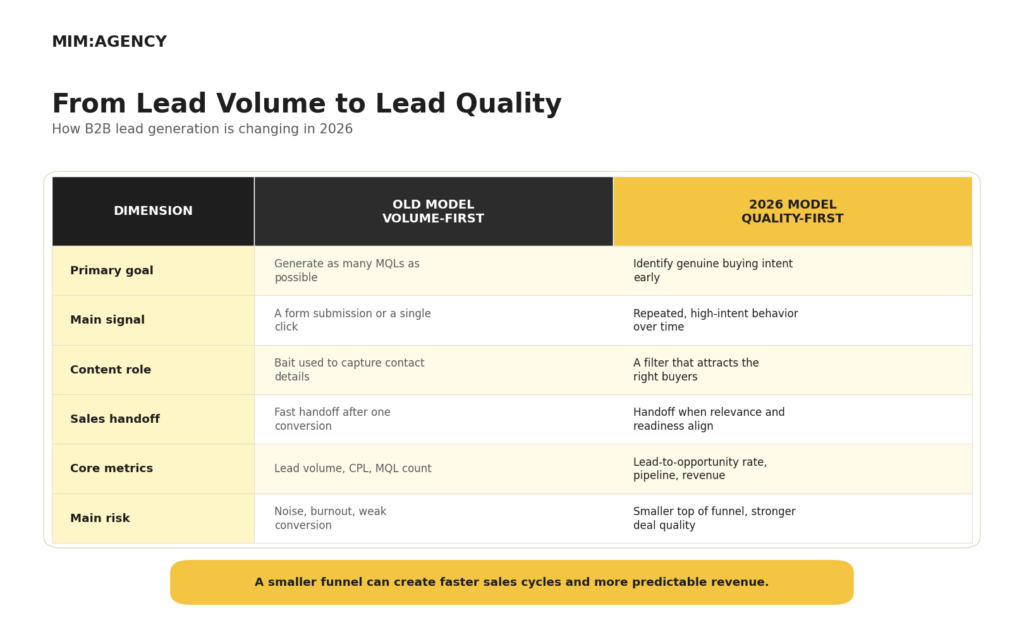
Readiness is more important than speed. Not every lead is ready to talk to sales right now – and that’s okay. A quality-focused strategy guides people naturally, through nurturing and relevant content, rather than pushing for a quick conversion.
Context is more important than a profile title. A “director” title doesn’t automatically mean decision-making authority. The company’s priorities, current challenges, and stage of business growth speak volumes more than a line on LinkedIn.
Lead generation based on signals, not forms
The “form-first” model is being replaced by an approach that relies on behavioral signals rather than a one-time conversion action. What matters isn’t exactly where a person filled out a form, but how they interact with content over time. Patterns matter, not isolated clicks. Long-term intent matters, not a quick click on a link.
The question “how to generate more leads this quarter” is gradually shifting to another: “how to identify genuine purchase intent earlier and respond to it more effectively.” And this shift in focus is reshaping everything – from content strategy to how marketing and sales interact.
Content as a filter, not as bait
In a quality-focused model, content ceases to be a hook designed to catch someone. It becomes a filter – and the best B2B content of 2026 does three things at once.
It’s honest. Content that’s too polished or “salesy” undermines trust. Buyers want clarity, real trade-offs, and a practical perspective – not hype.
It’s specific. General content attracts a general audience. Specific content attracts people who recognize their own problem in the text. Narrowing the focus doesn’t limit opportunities – it makes them sharper.
It’s useful even without a form. Content without a lead generation form builds trust and allows people to explore the topic on their own. Using lead generation forms becomes a conscious decision for high-intent moments, rather than a default practice for everything. Often, high-quality leads are precisely those who read several freely available articles before filling out a form for the first time.
Metrics will also need to be reevaluated
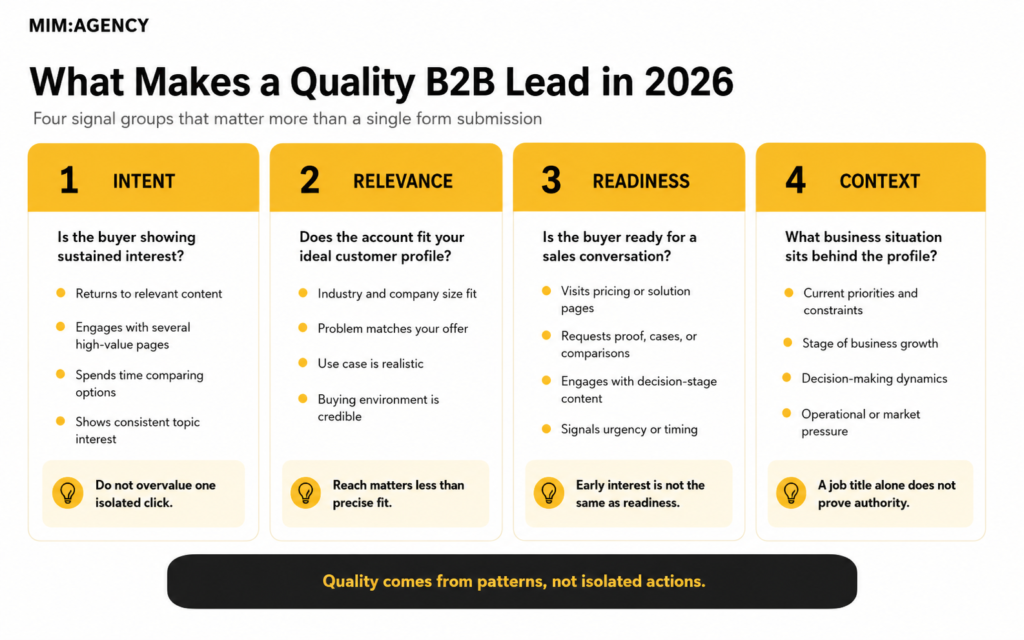
If the goal is quality, old metrics no longer tell the whole story. The leading teams of 2026 will instead focus on the depth of engagement rather than the number of clicks, the conversion rate from lead to opportunity, the speed and willingness of the sales team to take on a lead, as well as the actual contribution to the pipeline and revenue.
This isn’t a rejection of metrics altogether – it’s about measuring what truly drives the business forward.
Sales and marketing alignment is no longer a nice-to-have, but a condition for survival
Quality-focused lead generation cannot operate in isolation within a single department. Alignment in 2026 is more than just a shared dashboard. It’s a shared definition of what a “quality lead” actually means, regular feedback that refines targeting and messaging, and shared responsibility for the funnel’s results.
When marketing understands what actually converts, and sales understands the path the buyer took to reach the conversation – lead generation ceases to be a point of friction between departments and becomes an engine of growth.
Slower at the top of the funnel – faster where it really matters
The main misconception about a quality-driven approach is the belief that it slows down growth. In practice, the opposite is true. The top of the funnel may appear smaller, but further down the funnel, everything improves: a higher percentage of closed deals, a shorter sales cycle, stronger customer relationships, and more predictable revenue.
Growth ceases to be a race for numbers and becomes a matter of sustained momentum.
Conclusion
If your lead generation strategy is still built around the principle of “filling the funnel as quickly as possible” – perhaps now is the time to pause and rethink your approach. The future belongs to teams that value insight over volume, alignment over automation, and genuine relationships over one-time transactions.
