
Respectful Advertising and the Ethics of Automation
Automation makes it just as easy to scale personalization as it does manipulation. MIM:AGENCY breaks down where the line of respectful advertising actually sits, and the principles that keep teams from crossing it for the sake of conversion.

In marketing, we’ve reached a point where no one disputes the speed of content generation – but doubts arise elsewhere. How respectfully do we treat our audience when we automate the process? The MIM:AGENCY team explored where the line lies between effective automation and advertising that loses respect for the person on the other side of the screen.
The term “respectful advertising” – thoughtful, respectful advertising – emerged not as a marketing trend, but as a reaction to the audience’s very real fatigue with personalization that has turned into surveillance, and automation that has turned into manipulation. This isn’t about abandoning AI tools. It’s about how to use them without losing the trust upon which all communication with customers is built.
What Mindful Advertising Really Is
Mindful advertising is an approach in which the audience is viewed as people with a right to privacy, choice, and their own pace of decision-making – rather than as a set of behavioral signals that need to be converted into action as quickly as possible. In practice, this means several things at once: the ad message does not exploit anxiety, fear, or uncertainty to rush a purchase; personalization is based on data that a person has consciously provided, not on data collected without transparency; users are not pushed toward a decision by artificial scarcity or a fake timer; and advertising contact can be easily stopped or limited.
The main problem is that automation and AI targeting technically allow for the opposite – and do so so effectively that it’s easy to cross an ethical line without even realizing it.
Where automation actually helps
Before discussing the risks, it’s worth honestly acknowledging: automation in advertising isn’t the enemy of attention – it’s often the very tool that helps ensure it.
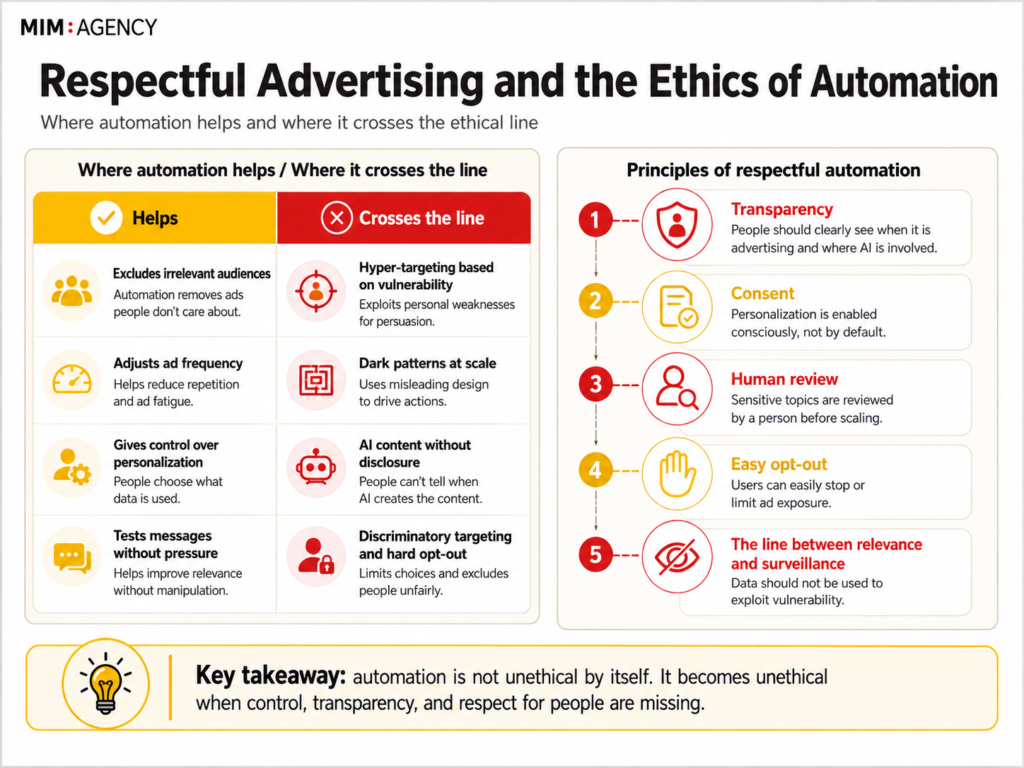
Excluding irrelevant audiences. AI is good at not showing ads to people who definitely don’t need them – this saves their time and attention just as much as it saves the advertiser’s budget.
Adjusting ad frequency. Automated systems can limit the number of times a user is exposed to the same ad, preventing the “nuisance effect,” which annoys the audience more than any other campaign mistake.
Transparent personalization settings. When AI is used to give users real control over the ads they see – that’s automation working in the service of respect, not against it.
Testing messages without putting pressure on people. A/B testing of formats, headlines, and visuals using AI allows you to find effective solutions without exploiting psychological triggers directly on a live audience through trial and error.
Where automation starts to cross the line
This is where the real complexity lies – because each of these mechanisms technically “works” and boosts conversion rates, which is precisely why teams rarely pause to ask themselves an uncomfortable question.
Hyper-targeting based on vulnerability. Algorithms are excellent at determining a user’s emotional state based on their behavior – and they’re excellent at monetizing that very moment. Weight-loss ads that appear after a search for eating disorders; financial products targeted at people in the midst of a debt crisis – these aren’t hypothetical cases, but standard practice in algorithmic optimization, unless it’s deliberately restricted.
Dark patterns, automated for scale. Artificial scarcity (“only 2 spots left”), fake social proof, hidden subscription terms – all of this can be scaled using AI just as easily as honest content. Automation doesn’t make dark patterns any less manipulative – it makes them harder to detect, because they’re generated and tested by machines rather than written manually by humans.
AI-generated content without disclosure of its origin. Synthetic voices, computer-generated faces in ads, AI-generated reviews passed off as real – this is the moment when the audience trusts a source that doesn’t exist. This isn’t a matter of aesthetics, but of honesty: people have the right to know who or what they’re interacting with.
Discriminatory targeting hidden in “neutral” data. An algorithm doesn’t necessarily explicitly exclude a group of people based on a specific characteristic – often this happens indirectly, through correlations in the data that no one has specifically checked. The result is the same: part of the audience systematically misses out on opportunities that others see.
No easy way out. If it’s technically impossible (or deliberately made difficult) to unsubscribe, limit personalization, or delete your data – that’s no longer automation for convenience, but automation designed to retain users against their will.
The Principles We Follow
Mindful advertising doesn’t mean sacrificing effectiveness – it means that effectiveness isn’t the only criterion for decision-making. In our work with clients, we rely on several guiding principles.
Transparency instead of invisibility. If content is AI-generated, if personalization data is collected through tracking, or if it’s an ad rather than organic content – this should be clear without having to read the fine print.
Consent instead of default. Personalization works best when a person has enabled it themselves, not when they simply overlooked a checkbox.
Human review before scaling. Any AI-generated campaign, especially on sensitive topics – health, finance, mental well-being – is reviewed by a human for manipulative content before reaching a broad audience.
Ease of opt-out as a standard, not a concession. The ability to reduce or stop ad exposure is built into the campaign from the start, rather than added after complaints.
The line between personalization and surveillance. Using behavioral data is acceptable when it improves relevance. It ceases to be acceptable when it begins to exploit a person’s vulnerability as leverage.
How this looks at the team level
Ethical automation rarely fails due to malicious intent – more often because no one on the team asked the right questions in time. Therefore, the practical part of this approach isn’t a declaration of values, but a workflow: checking targeting segments to ensure they don’t include people in a state of crisis; reviewing creatives for artificial scarcity or fear-mongering; labeling AI-generated content where it affects trust; testing the opt-out path just as thoroughly as the conversion path.
None of these steps significantly slows down the campaign. But each one represents a moment where the team consciously decides not to use a feature simply because it’s technically available.
Key Takeaway
Automation does not make advertising unethical in and of itself – it simply removes the barriers that previously limited the scale of manipulation: human fatigue, a limited number of hypotheses, and manual moderation. What once required the dishonesty of a single person may now require only the inattention of an algorithm.
Mindful advertising is the decision to keep people at the center of the process even when technology makes it possible to forget about them. And it is precisely this – not the speed of creative generation – that remains the true competitive advantage in a market where audience trust is becoming an increasingly scarce resource.
