
What Marketers Need to Know About Generative AI in Content
Generative AI is no longer an experiment in content marketing – it's part of the daily workflow. But the speed at which brands are adopting AI-generated content often outpaces their understanding of where it actually creates an advantage and where it introduces risks to quality and audience trust. The MIM:AGENCY team broke down what marketers really need to know about generative AI in content to use it effectively, not blindly.

Creating content has always been resource-intensive. Research, drafting, editing, and optimization – a single piece of high-quality content can easily take a marketer several hours to produce. AI offers a chance to reclaim some of that time – not because it replaces the creative process, but because it takes on the routine tasks that consume the most time in B2B marketing teams.
The question is no longer whether AI will be involved in content creation – it already is. The question is different: how to use it wisely. Where does automation speed up work without sacrificing quality, and where are human decisions still irreplaceable? Understanding this boundary determines whether AI will become a productivity tool or just another source of mediocre content.
How AI Actually Generates Text
Before discussing applications, it’s worth understanding what happens “under the hood.” Language models are trained on massive datasets – books, articles, and research papers. They learn patterns of how language works: which words typically follow one another, how sentences are constructed, and the structure of different types of text.
When you give the model a prompt, it doesn’t search for information online or query a database. Instead, it predicts the most likely next word based on the patterns it learned during training. That’s why AI handles structure and grammar well but struggles with originality – it combines existing patterns rather than creating new ones.
For content teams, this means one simple thing: AI works well where tasks are based on patterns – formatting, structuring, and rephrasing. And it performs poorly where something truly new or strategically nuanced is required.
What AI Does Well: Automating Routine Tasks
AI excels in areas involving structure, repetition, and patterns. For a content marketer, this includes several tasks that don’t require creative solutions but are time-consuming.
Research and information gathering. Before writing anything, a marketer spends hours collecting data, studying competitors’ content, and searching for sources. AI significantly shortens this phase – it synthesizes information from multiple sources, identifies patterns in industry reports, and finds relevant statistics faster than manual searches. For B2B in technical industries – manufacturing, life sciences – this means quickly compiling technical specifications or regulatory requirements without having to manually review dozens of white papers.
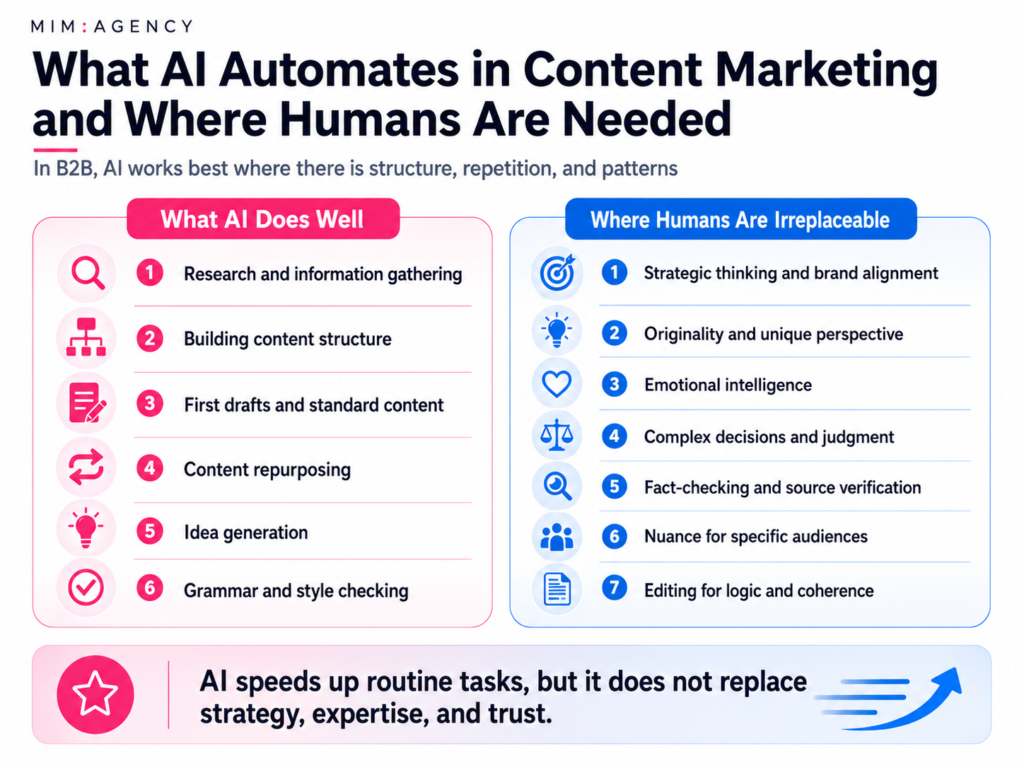
Structure development. A blank page takes time just to figure out “where to start.” AI generates a structural framework – provide the topic, audience, and key points, and you’ll get an outline with a logical sequence of sections. It’s not a perfect outline – it doesn’t reflect the brand’s voice or understand strategic nuances – but it eliminates the initial friction of organizing your thoughts.

First drafts and standard content. AI handles texts with predictable structures well – product descriptions, FAQs, standard email sequences, and meta descriptions. For SEO, it can immediately insert keywords within character limits. These drafts still need to be reviewed by a human for accuracy and brand consistency, but the basic formatting is already done.
Content reformatting. Turning a long blog post into social media posts, newsletter headlines, or presentation slides is a routine task. AI adapts the tone and length to different formats while preserving the core message. If you already have in-depth material – such as a detailed strategy guide – AI will quickly extract key insights from it and repurpose them for LinkedIn or a newsletter.
Idea generation. A content plan requires a constant stream of new topics. AI generates dozens of options based on keyword research or competitor analysis. Not all options will be viable, but the sheer volume helps you break out of a creative rut. Use AI for divergent thinking – generating many options – and reserve the right to choose which ones are worth your attention.
Grammar and style checking. Proofreading takes time. AI catches grammatical errors, flags passive voice and complex sentences, and offers readability tips faster than manual editing. It doesn’t replace an editor with a feel for tone and coherence, but it takes care of superficial corrections.
What AI Can’t Do: Where Human Expertise Is Indispensable
AI has clear limitations, and understanding these limits saves you from wasted effort and poor results.
Strategic thinking and brand alignment. AI doesn’t understand your business goals, competitive positioning, or audience psychology. It cannot determine whether a specific piece of content serves your marketing strategy. A company that positions itself as innovative communicates differently than one that emphasizes reliability. AI can mimic tone on a superficial level, but it doesn’t grasp the strategic logic behind the messaging.
Originality and a unique perspective. AI generates text by recognizing patterns in existing data. This results in predictable, derivative content. It doesn’t offer a fresh perspective, challenge established beliefs, or formulate truly new ideas. In B2B, where thought leadership is what sets brands apart, this is a critical limitation. AI can summarize what others have already said on a topic, but it is incapable of constructing a contrarian position or synthesizing disparate concepts into an original insight.
Emotional intelligence. Content that resonates emotionally requires an understanding of the audience’s pain points, aspirations, and unspoken fears. AI lacks this – it won’t sense when a message sounds out of place or when a different phrasing would better resonate with the reader. For topics such as organizational changes, market upheavals, or financial uncertainty, human empathy is essential.
Complex decisions and judgments. When content requires weighing competing priorities or ethical nuances, AI generates options but cannot determine which one is right for your specific situation. When creating a guide on marketing automation, AI will include case studies, specifications, and implementation timelines – but it’s up to you to decide which case study best demonstrates your expertise.
Fact-checking. AI generates plausible text, but plausibility is no guarantee of accuracy. It confidently makes statements that may be false, cites nonexistent sources, or provides outdated information. Every fact generated by AI requires human verification – especially in technical fields involving regulatory requirements or statistics.
Nuances for specific audiences. Different audiences require different approaches. A procurement specialist evaluating equipment is interested in cost and supplier reliability. An engineer focuses on technical specifications and compatibility. AI can superficially adjust the tone, but it cannot provide the deeper contextual understanding that makes content truly targeted.
Editing for coherence. AI generates grammatically correct sentences but often produces disjointed paragraphs lacking narrative logic. Transitions feel mechanical, and ideas don’t build on one another in a coherent sequence. That sense of when a paragraph needs to be reordered, when an example clarifies rather than confuses, or when the text’s pace drags – that’s intuition that can’t be automated.
How to Build a Workflow with AI
The goal isn’t to automate everything – it’s to automate the right things.
Start with strategy, not with the tool. Before you even bring AI into the picture, define your content goals: which audience you’re targeting, what action you want to elicit, and how this material fits into your overall strategy. AI won’t answer these questions – use it only after the strategic direction has already been determined.
Use AI for research and structure. Let it do the initial heavy lifting – gathering data, generating a topic outline, and suggesting angles. This shortens the early research phase and provides a structural foundation. Review the results critically: is the proposed structure logical, and are there any gaps?
Write the draft with human expertise. Use the AI-generated outline as a starting point, but write the text yourself – or at least heavily edit the AI draft, adding perspective, originality, and your brand’s voice. If you’re creating content about lead generation strategies, the AI will provide a general overview – but you’ll be the one to add the specific examples, lessons from real-world case studies, and strategic recommendations that make the text valuable.
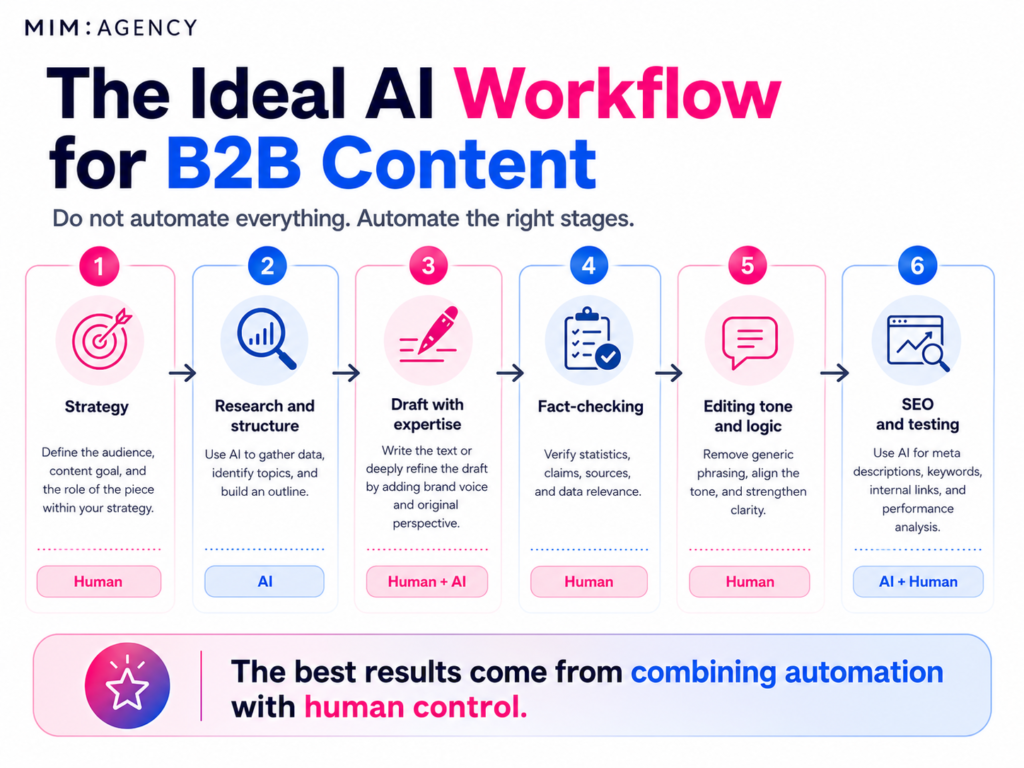
Check everything. Any statistics, claims, or references generated by AI need to be verified for source and data accuracy. In technical fields, this means cross-checking with authoritative sources, regulatory documents, or internal experts.
Edit for tone and coherence. Even heavily edited AI-generated content often retains a generic, impersonal tone. Read the text through the eyes of your target audience: does it sound like your brand, and does the narrative flow naturally? Rewrite formulaic passages, add specific examples, and remove unnecessary repetitions. It’s at this stage that good content becomes truly high-quality.
Optimize with AI. Once the text is finalized, use AI for SEO tasks – checking keyword density, generating suggestions for meta descriptions, and identifying opportunities for internal linking.
Test and refine. Compare how AI-assisted content performs against fully human-written content – in terms of engagement, leads, and impact on conversion. If AI-generated content consistently misses important topics, adjust your prompts or add more human oversight during the planning phase.
Practical Implementation Tips
Not all AI tools are the same. General-purpose models offer flexibility, while specialized tools are better tailored to specific tasks – such as SEO, social media, or email automation. Evaluate tools based on how well they integrate with your existing tech stack – disparate tools create friction in the process.
Train your team. A tool is only as effective as the skill with which it’s used. It’s worth investing time in training your team in prompt engineering and recognizing AI’s limitations. Establish internal guidelines: when to use AI and when to rely solely on human expertise.
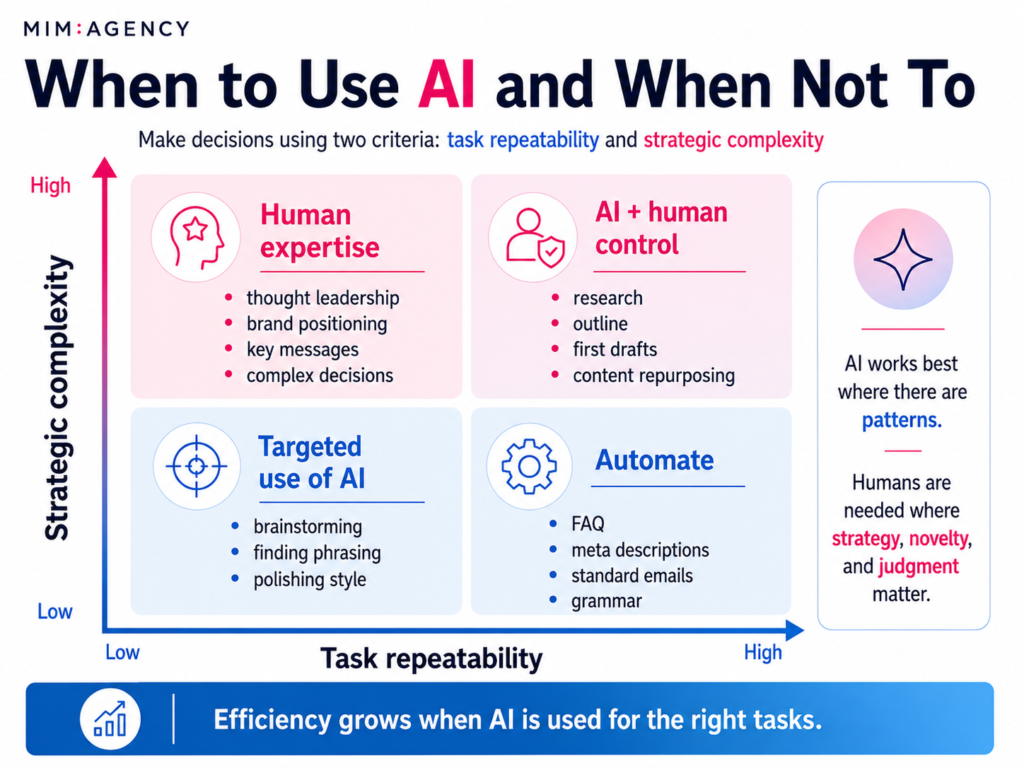
Quality control. Build a review process that identifies and corrects AI errors before publication. Assign someone to verify facts, ensure brand consistency, and uphold editorial standards. Quality control becomes even more important – not less – when AI is involved; a gain in speed is worthless if it comes at the expense of accuracy or trust.
Balance between efficiency and authenticity. The biggest risk with AI-generated content is text that is technically sound but lacking in substance – grammatically correct but devoid of character. Content that comprehensively covers a topic but offers no unique perspective. The audience senses this difference. In B2B, where decisions are based on trust and relationships, faceless content actively harms the brand.
Key Takeaway
AI changes how content is created, but it doesn’t change what makes content effective. Understanding the audience, strategic positioning, an original perspective, and building trust – these remain exclusively human domains.
Think of AI as an assistant that handles the routine tasks: gathering information, structuring, formatting, and optimization. This frees up the team for strategic thinking, creative insight, and sound judgment. The time savings are real, and the increase in efficiency is measurable – but only if AI is implemented thoughtfully and does not replace human decision-making where it is still necessary.
