
AI Agents in 2026: Real Potential or Limitations for Business?
The MIM:AGENCY team analyzed 2026 global data on AI agents: only 7 out of 18 market-leading products actually qualify as real agents. We break down where the technology delivers real impact versus marketing hype — and what it means for Ukrainian and global businesses.

The word “agent” is now included in the pitch for any AI product – from a chatbot with integration to a fully autonomous system. The MIM:AGENCY team analyzed the latest data from international market researchers and reviewed more than fifty real-world case studies of AI implementation at large companies around the world, drawing its own practical conclusions for Ukrainian businesses. The key thing to know right now: most solutions marketed as “agents” are not actually agents, and the impact of true agency manifests itself in places entirely different from where it’s most heavily promoted in the media.
Artificial intelligence in 2026 is no longer a question of “to implement or not to implement.” 88% of companies worldwide use AI in at least one business function. The real question is: why, given such widespread adoption, do only 6% of companies worldwide report a noticeable financial impact (on EBIT)? The answer is the key insight of this article.
Agent or Assistant: Why They Are Different Products
First and foremost – a fundamental distinction, without which any discussion of “agent implementation” becomes mere marketing. There is still no universally accepted definition of the term “AI agent,” so each vendor interprets it in its own way. By synthesizing the formulations of leading industry players, we can offer the following working definition:
An AI agent is an autonomous system that operates in a feedback loop: it independently plans actions, executes them, monitors the results, and adjusts its approach, completing the task without constant human intervention.
The difference from an assistant is simple: you set a goal for the agent, and it decides on its own how to achieve it. An assistant needs to be told every single step. Imagine the difference between telling a chef, “Dinner for four, one vegetarian,” and giving step-by-step instructions like, “Take 200 grams of flour, preheat the oven to 180 degrees.”
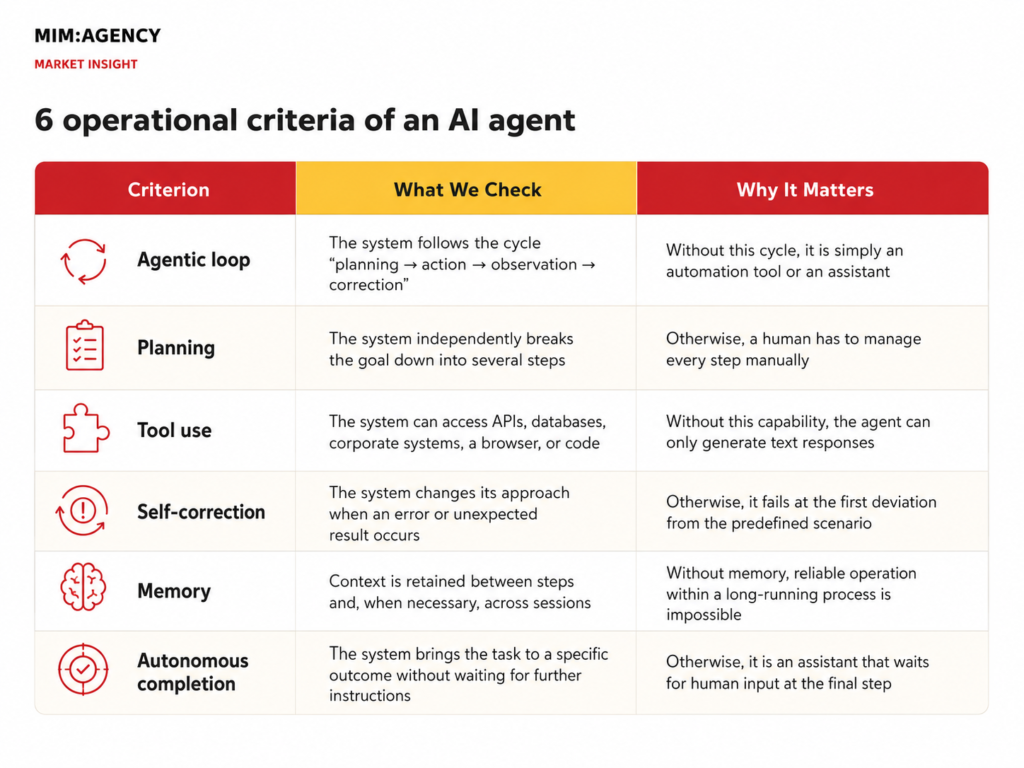
To distinguish true agency from marketing hype, analysts use six operational criteria:
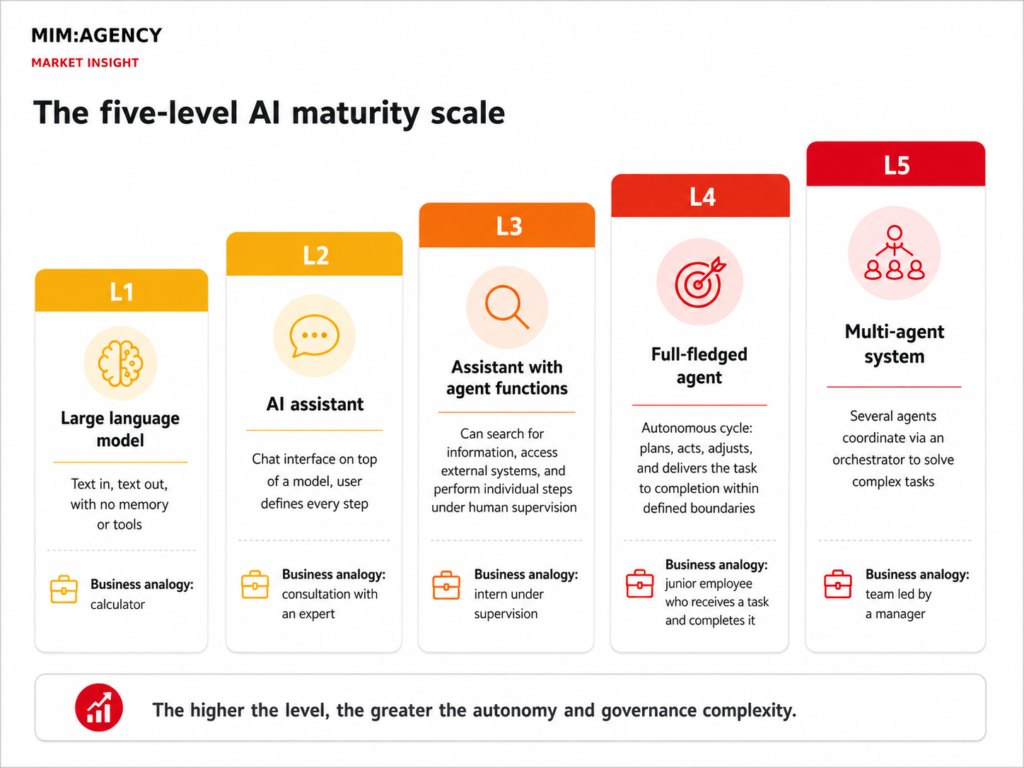
Based on these criteria, a five-level maturity scale is constructed:
Market review: Of 18 global leaders, only 7 were found to be agents
Analysts evaluated 18 global market-leading products against these six criteria. Only 7 solutions (39%) met the threshold for a full-fledged agent (L4): Claude Code, Devin, Codex by OpenAI, Operator, Cursor, Harvey, and Manus. Another 3 were classified as “agents with limitations” (ChatGPT’s agent mode, GitHub Copilot, and Glean agents), while the remaining 8 are AI assistants of varying levels of sophistication (including Microsoft 365 Copilot, Gemini Advanced, and McKinsey’s internal Lilli platform), which are merely referred to as agents in marketing materials.

This is not an isolated case. When McKinsey publicly claims to have 25,000 “personalized AI agents” alongside its 40,000 employees, and BCG claims to have 18,000 “GPT agents,” competitors directly question these figures. EY’s Chief Engineering Officer, Steve Newman, noted that the number of agents does not directly correlate with the value created, while PwC’s Head of AI, Dan Priest, called the sheer number of agents likely an incorrect metric for evaluation. For businesses, the practical takeaway is this: the number of “agents” a vendor boasts about says nothing about real-world benefits. What matters is the architecture of a specific solution tailored to a specific task.
“The Damping Cascade”: Why Lab-Based Acceleration Doesn’t Translate to Profit
This is where the main paradox of 2026 lies. At the level of a single micro-task under laboratory conditions, AI delivers impressive speedups – up to 55.8% (based on a study using GitHub Copilot, 95 programmers, and a single task). But as soon as the task moves to the level of a real project with existing code, dependencies, testing, and integration, the effect dissipates: a randomized experiment using the METR methodology showed that experienced developers in real-world conditions complete tasks 19% slower, and DORA metrics at the organizational level do not improve at all. Developers subjectively feel that they are working faster – but the company does not start releasing products faster or with higher quality.
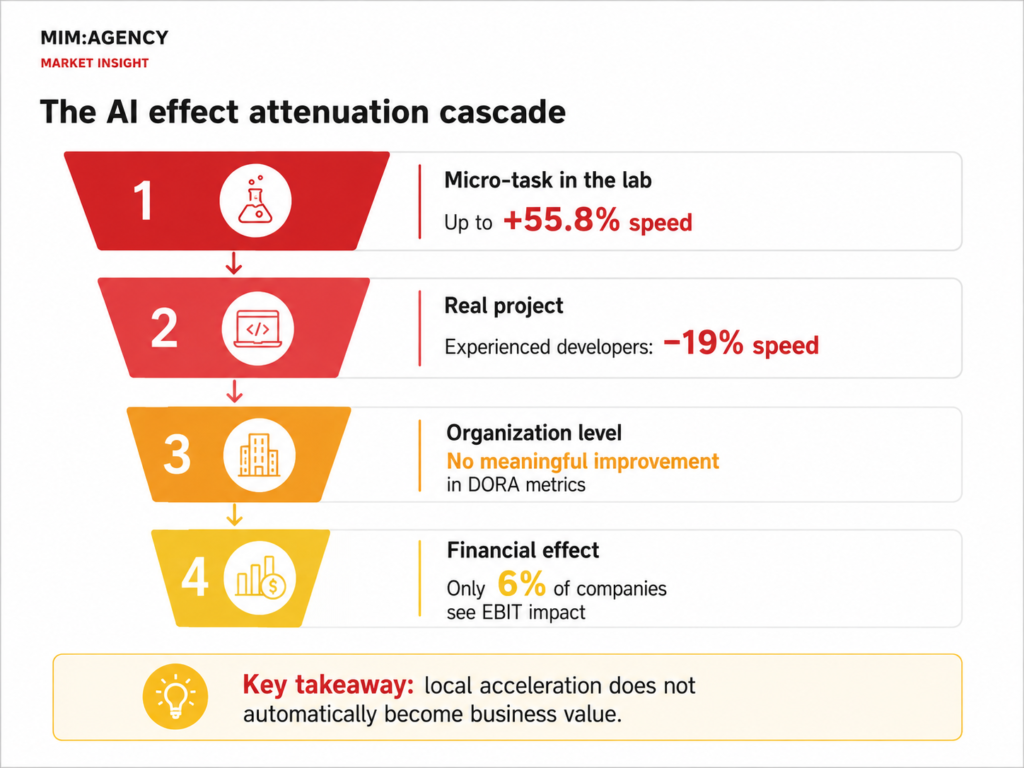
This phenomenon is the “attenuation cascade” of the AI effect: the closer you get to the organization-wide level, the less remains of the initial acceleration. The reason lies not in the technology itself, but in the fact that gains at the individual employee level do not automatically translate into a restructuring of the entire process. The result: 95% of pilot projects do not recoup their investment within the first six months, and 80% of companies do not see any impact of AI on their financial results.
Where the Impact Is Real: Proven Case Studies from the Global Market
The picture isn’t the same everywhere. Where the solution architecture is truly agent-based (L4 and above) – rather than merely assistant-based – the impact is measurable and significant:
- Anthropic (in-house Claude Code): the number of merged pull requests per engineer increased by 67%, and the team released over 30 product updates in 52 days.
- Amazon Q Developer: helped migrate tens of thousands of applications from Java 8/11 to Java 17, reducing the work that would have taken over 4,500 person-years – a savings of $260 million per year. However, this was a one-time technical task, not a repeatable process – it’s important to understand this before scaling expectations to the entire business.
- Waymo: Self-driving taxis are making 500,000 paid trips per week in 10 U.S. metropolitan areas (as of March 2026); operators intervene only when prompted by the system.
- BASF: The first AI-powered reactor autonomously plans and carries out chemical reactions, optimizing product yield – experiments showed a 20-fold increase in speed compared to manual operation.
- John Deere (See & Spray): Autonomous tractors equipped with computer vision precisely spray weeds – saving 31 million gallons of herbicides across 5 million acres in 2025.
- BCG for a shipbuilding company: a multi-agent system designs ship structural components – engineering costs fell by 45%, and the design time was reduced from 5 days to 1.
Here’s an example that everyone planning to replace humans with AI in customer service should know about – the Klarna case. Media reports typically mention that the company cut costs by $40 million and laid off 800 employees. But the official SEC F-1 filing reveals the details: the $39 million in savings represents just 1.3% of the company’s total operating expenses for 2024. And most importantly: in May 2025, Klarna’s CEO publicly acknowledged that the company had “gone too far” in replacing humans with AI and resumed hiring customer service agents. The AI assistant handled 62% of support inquiries on its own – but even at that level, complex and disputed cases required bringing humans back into the service loop. MIM:AGENCY’s practical conclusion: Don’t build a business case on completely replacing humans with an AI agent. A more effective model is collaboration, where the agent handles routine tasks, a human reviews decisions at the outset, and as the system gains experience, it gradually becomes more autonomous.
Another interesting finding from the analysis of 43 documented implementations at large companies: AI agents are used significantly more often in back-office functions (internal communications, HR, IT, supply chains, R&D, finance) – 51% of cases – than in front-office functions that deal with customers (customer service, marketing, sales) – 37%. At the same time, the maturity level of solutions in both groups is comparable (primarily L3–L3.5). It’s just that front-office use cases are more high-profile and more frequently featured in the media. Practical conclusion: starting with the back office is not a weakness, but a prudent decision. There are lower reputational risks there (an agent’s mistake isn’t visible to the customer) and higher ROI predictability.
Maturity Map by Industry: Where It’s Already Working, and Where It’s Still Too Early
Analysts have constructed a maturity matrix of 16 industries across 10 business functions (160 cells). Only about 31% of them are filled – this is a clear signal: if your industry or function falls into an empty cell, the market there isn’t ready yet, and the “agent” being offered to you will most likely turn out to be just a regular assistant dressed up as an AI. Examples of barriers:
- – healthcare – regulatory restrictions (in the U.S., the FDA only allows AI with fixed algorithms, and HIPAA restricts the exchange of patient data) are delaying the deployment of fully-fledged agents until at least 2028–2029;
- – public sector – the EU’s AI Act requires human oversight of high-risk systems;
- – hospitality industry – outdated reservation systems lacking integration interfaces (a telling example: McDonald’s halted a pilot project for taking orders via AI due to poor quality);
- – Construction – 80% of the work involves data collection and preparation; outdated IT systems hinder integration.
An empty cell is not a reason to ignore the technology forever, but rather a guide: it’s not worth spending your budget right now on a “full-fledged agent” where the market isn’t technically ready yet; however, it’s a real opportunity for a pioneer willing to invest with a 1-2-year time horizon.
Market Size and Asia as an Alternative Ecosystem
In monetary terms, the AI agent market (including the full spectrum of solutions, from simple chatbots to autonomous systems) was estimated at approximately $7.8 billion in 2025, with projections of growth to $200 billion by 2028 and over $450 billion by 2035. However, this is the overall market; the segment of Level 4 and higher solutions is significantly smaller.
The Asian market, which is developing in parallel with the U.S. market, deserves special mention. In China, 67% of industrial companies have adopted AI for commercial use, compared to only 34% in the U.S. In April 2026, Alibaba released the Qwen3.6-Plus model with an agent-based architecture, deeply integrated into the group’s ecosystem of services (Taobao, Alipay, Fliggy, AMap) – the search engine has evolved from a suggestion tool to an action executor. At the same time, Baidu launched the open agent platform OpenClaw with the corporate add-ons DuMate (a desktop agent with a local isolated environment) and DuClaw (a cloud service requiring no deployment), integrated into the company’s flagship search engine, which reaches approximately 700 million users monthly – the world’s largest public example of agent implementation in terms of reach as of early 2026.
For Ukrainian companies operating in international markets or with Asian partners, this ecosystem is no longer a novelty but a real benchmark for comparing architectural solutions.
What This Means for Ukrainian Businesses: MIM:AGENCY’s Conclusions
After analyzing this data, our team identifies several practical implications for companies operating in Ukraine and expanding into international markets:
First. Before signing a contract with a vendor, verify exactly what you’re being sold – an agent or an assistant. These are two distinct categories of solutions with different prices, different implementation budgets, and different upper limits on effectiveness. The most common mistake is paying for an agent but getting an assistant – or, conversely, building an expensive agent infrastructure when a simple assistant would suffice.
Second. A pilot project should focus on a single, repeatable scenario (processing one type of inquiry, verifying one type of document), rather than an entire functional area (such as “customer service” or “document management” in its entirety). Attempting to overhaul an overly large system is the main reason why pilot projects get bogged down in approvals.
Third. Don’t automatically count on staff reductions as the main benefit of AI. Real financial results more often come from revenue growth (new AI-based products, increased conversion rates and average transaction value in existing business, monetization of accumulated data) rather than from staff cuts. Companies that truly boost productivity through AI, in the vast majority of cases (83%, according to the EY AI Pulse Survey), do not cut staff – they reassign people to more complex tasks.
Fourth. Responsibility for the process during the pilot should lie with a business representative, not the IT department. IT specialists optimize model accuracy and API response times, not request processing times or customer satisfaction – and that is precisely why IT-led pilots more often conclude that “AI doesn’t work,” when in reality it is the accountability structure that is failing.
Fifth. Be prepared for a temporary drop in metrics immediately after changing employee KPIs – this is a normal manifestation of the J-shaped learning curve, not a reason to shut down the project.
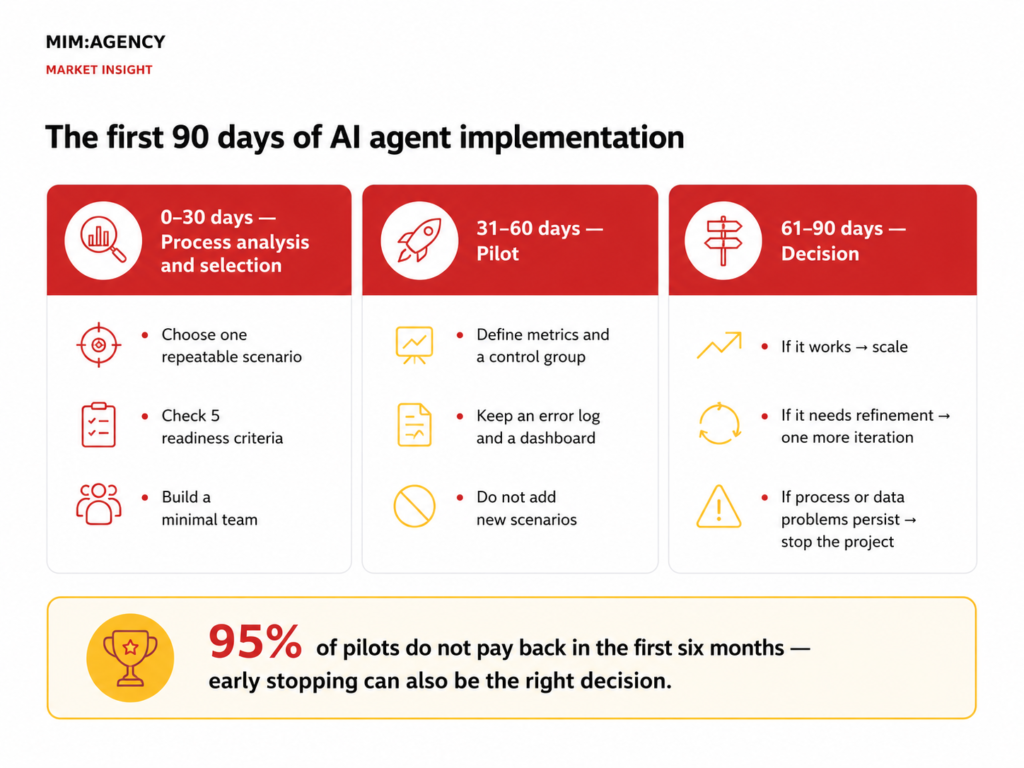
A practical checklist from MIM:AGENCY: the first 90 days of implementation
First 30 days – analysis and process selection
- Select a single repeatable scenario (not an entire functional area): thousands of identical operations each month, a template-based scenario.
- Evaluate it against five readiness criteria:
- Is the process repeatable and large-scale?
- Are there clear success criteria?
- Is the data available in digital form?
- Is the cost of error acceptable?
- Can the process operate without verifying every decision?
- If at least three answers are “no,” it’s too early to implement an agent: simpler L3-level automation is a better starting point.
- Assemble a minimal team: a project sponsor from top management (10–20% of their time), a product owner from the business side (not from IT!), an AI engineer, and a data engineer.
The next 30 days – the pilot project
- Define target metrics and a control group before launch.
- Organize weekly reviews of results, a log of errors and solutions, and a metrics dashboard.
- Don’t add new scenarios – focus on capturing the impact within a single process.
The final 30 days – deciding the next steps
- Metrics achieved and unit economics are positive → scale up.
- You’re on the right track, but refinements are needed → one more iteration.
- Metrics not achieved due to process or data issues (not technology) → halt the project. This is normal: 95% of pilots don’t pay off in the first six months, and halting the project isn’t a failure – it’s a way to conserve resources.
Three common mistakes to avoid
- Don’t change employee KPIs after implementation – otherwise, the effect wears off in 2–3 months, and the team reverts to working without the agent.
- Don’t attempt to overhaul an overly large scope (an entire function instead of a single scenario).
- Don’t assign an IT representative – rather than a business representative – to lead the process.
What our team would do if we were implementing an AI agent for a client
At MIM:AGENCY, we apply this logic to our own work with clients’ content and marketing processes: Before proposing automation of customer interactions, analytics, or content generation via an AI agent, we evaluate the specific process against the same six criteria of agency and five readiness questions – rather than selling an “agent” just because it’s a buzzword in a presentation. If a client currently needs an assistant that speeds up the team’s work, we’ll say so, rather than selling a more expensive solution that won’t pay for itself.
If your company is considering implementing AI agents in marketing, customer service, or internal processes – the MIM:AGENCY team is ready to help you test your hypothesis on a specific scenario before investing in a large-scale transformation.
