
GEO for B2B: A New Standard of Visibility That Can’t Be Ignored
AI search no longer displays a list of links—it immediately provides a ready-made answer, and if a brand isn’t mentioned in that answer, it simply doesn’t exist for the user. The MIM:AGENCY team researched how Google, Microsoft, Anthropic, and Perplexity generate responses from generative systems and put together a practical plan: what businesses should do this quarter to remain visible in the age of AI search.

AI search no longer returns a list of links – it provides a ready-made answer. And if your brand isn’t in that answer, you simply don’t exist to the user. The MIM:AGENCY team conducted its own research into how Google, Microsoft, Anthropic, and Perplexity shape the responses of generative systems, and has prepared a practical plan for what businesses should do right now to remain visible in the era of AI search.
Search is no longer about “ranking.” It’s about whether you’re cited at all
Just a few years ago, success in SEO meant making it into the top 10 search results. Today, that’s not enough. The term “Generative Engine Optimization” first appeared in a 2023 academic paper, and initial controlled experiments have already shown that structural and textual optimizations can increase a source’s visibility in generative system responses by up to 40%. Research from 2025–2026 clarified the picture – AI search places greater trust in earned media and authoritative sources, is highly sensitive to page structure, and handles language and content freshness differently depending on the platform.
The main takeaway for businesses is simple but stark: success doesn’t go to those who are simply “in the index,” but to those whose content is easily indexed, broken down into meaningful chunks, aligned with the user’s search intent, cited as a source, and guides the user to the next step.
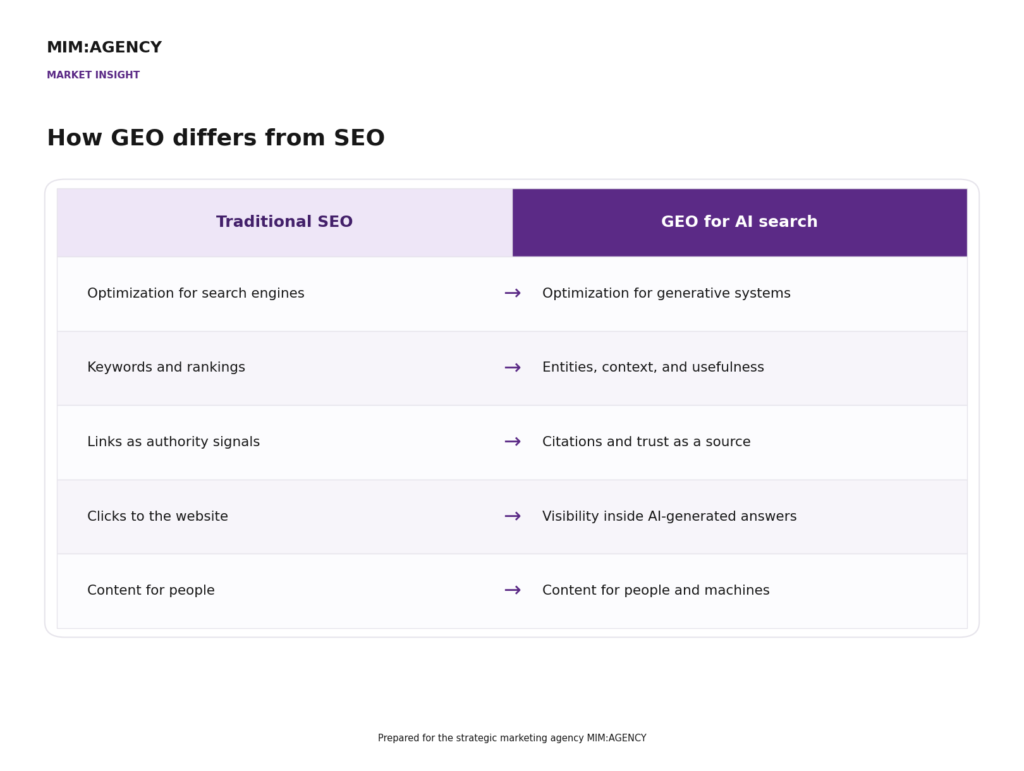
Google is no longer a search engine in the traditional sense – and that’s exactly what it’s banking on
Google transformed generative search from an experiment into a mass-market product in a matter of months. AI Overviews launched in the U.S. in May 2024; by October of that same year, they were operating in over 100 countries and reaching more than 1 billion users per month. In March 2025, AI Mode was introduced – a dedicated mode for complex, multi-step queries featuring a “query fan-out” function: the system automatically breaks down a single query into a series of parallel sub-searches.
At the same time, Google explicitly states: no new “magic” files or special markup for AI is required. The rules are the same as always for high-quality SEO – indexability, snippet-readiness, crawlability, text content instead of images alone, clear internal linking, and consistent, structured markup.
The numbers confirm this: in a large 2026 study, AI Overviews appeared in 51.5% of actual search queries, while nearly 30% of the domains cited by AIO don’t even appear on the first page of classic search results. In other words, “ranking at the top of Google” and “appearing in an AI answer” are two different goals.
Microsoft, Anthropic, and Perplexity play by different rules – and this matters for your content
Microsoft is developing another front – enterprise search. Azure AI Search combines vector search, hybrid search, and so-called agentic retrieval – where the system itself plans a series of parallel sub-queries and returns a structured response with clear citations and metadata. For B2B, this is critical: even if a customer sees a Copilot-style interface, the real battle for visibility takes place at the level of how your content is broken down into fragments and indexed.
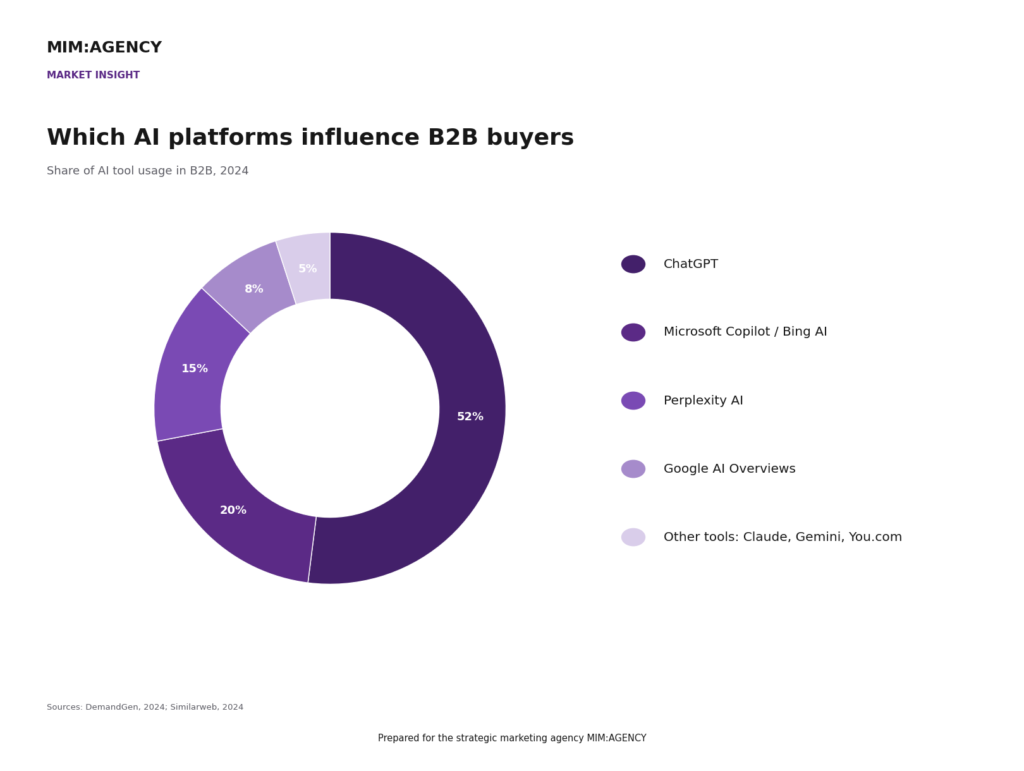
Anthropic focuses on mandatory real-time citations and source control. Perplexity takes a two-pronged approach: its Search API returns structured, ranked results, while Sonar immediately generates a ready-made response with embedded links. The conclusion is clear: optimizing for AI search is no longer just about working with the page’s text, but also about how the system “slices” your content into citable snippets.
Exact citations are not a guarantee of credibility
This is where the main pitfall lies. A study on verifiability for generative search systems showed that, on average, only 51.5% of generated sentences are fully supported by citations, and 74.5% of citations actually corroborate what the response claims. In a large-scale 2026 audit of AI Overviews, about 11% of claims were not supported by cited pages at all, and another study found signs of AI-generated sources in approximately 16% of links in ChatGPT, Copilot, Gemini, and Perplexity.
For businesses, this means one simple thing: it’s not enough to simply be mentioned. What’s said about you must actually match what’s written on your page – otherwise, you risk your reputation due to someone else’s synthesis error.
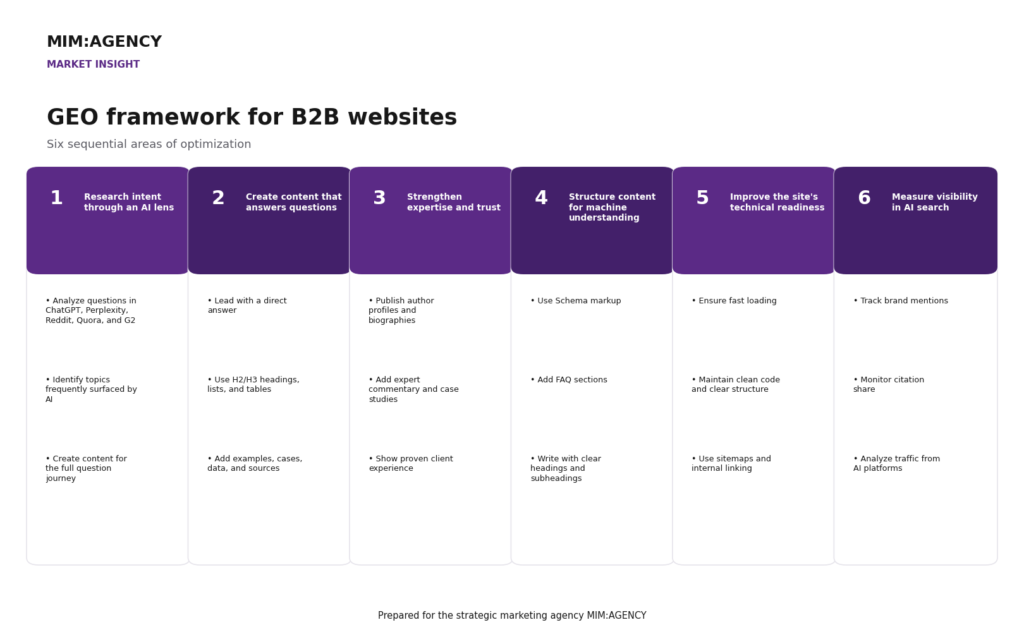
What a B2B website must have for AI systems to “understand” it
The technical foundation here hasn’t changed revolutionarily – it has become critically important:
- Indexing and crawling. No blocking of critical pages via robots.txt or CDN, a correct canonical tag on every page, and clean sitemaps containing only the desired URLs.
- Rendering. For sites with heavy JavaScript – server-side rendering or prerendering. Not all bots execute JS, and Google explicitly calls this a “good idea” even now.
- Text instead of images. Tables with specifications, prices, terms of service, FAQs – all of this should exist as text, not as images or PDF attachments, because retrieval systems work specifically with text fragments.
- Multilingual support. Correct `hreflang` tags or language-specific sitemap alternates with mandatory backlinks between versions.
- Structured markup. `Organization` on the homepage, `Article` for expert content, `BreadcrumbList`, and an FAQ-like structure – none of this guarantees inclusion in an AI response, but it greatly helps systems recognize entities on your site.
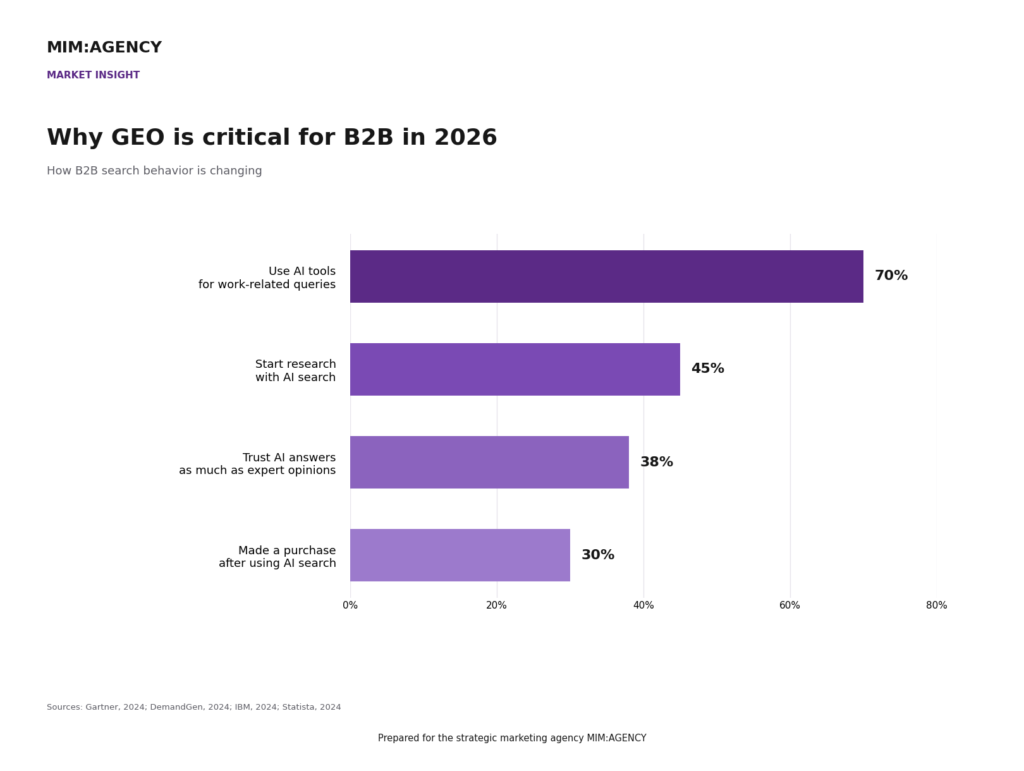
Content architecture: forget about “one big article about everything”
The most effective model for B2B is a hub-and-spoke structure with atomic pages, where each page addresses a specific user intent rather than trying to cover everything at once:
- Product or solution page – a clear answer to “what is it,” “who is it for,” and “how does it work”;
- a case study page – with specific figures, methodology, and timeframes;
- a comparison page – for queries like “X vs. Y” or “alternatives”;
- a pricing page – even without a final price, explain the calculation logic;
- documentation and integrations – precise technical facts that are easy to cite.
This aligns with how modern systems break down complex queries into sub-queries, and how retrieval mechanisms assess relevance at the level of individual fragments rather than the entire page.
Content must be written for both humans and systems
A combination of long-form and atomic content works best. Long-form content provides expertise and contextual depth, while short snippets offer precise definitions and facts that are easy to quote. The following work best:
- a clear, one-paragraph definition at the top of the page (“what this is” in 2–3 sentences);
- decision tables – “who it’s for / who it’s not for”;
- case studies with specific numbers, rather than general phrases about “success”;
- transparency regarding pricing, even if an exact amount isn’t provided;
- author and expert pages – with names, titles, and dates the content was updated.
Google explicitly recommends showing who created the content and adding an author byline – this builds trust with both people and quality-assessment algorithms.
Response speed is now part of a competitive advantage
Users expect a response within 3–5 seconds, which is why Microsoft addresses this through parallel processing of sub-queries. For a website, this means: a slow document hub, heavy JavaScript tables, and API delays not only undermine the user experience but also reduce the chance of being correctly “read” by the system when generating a response.
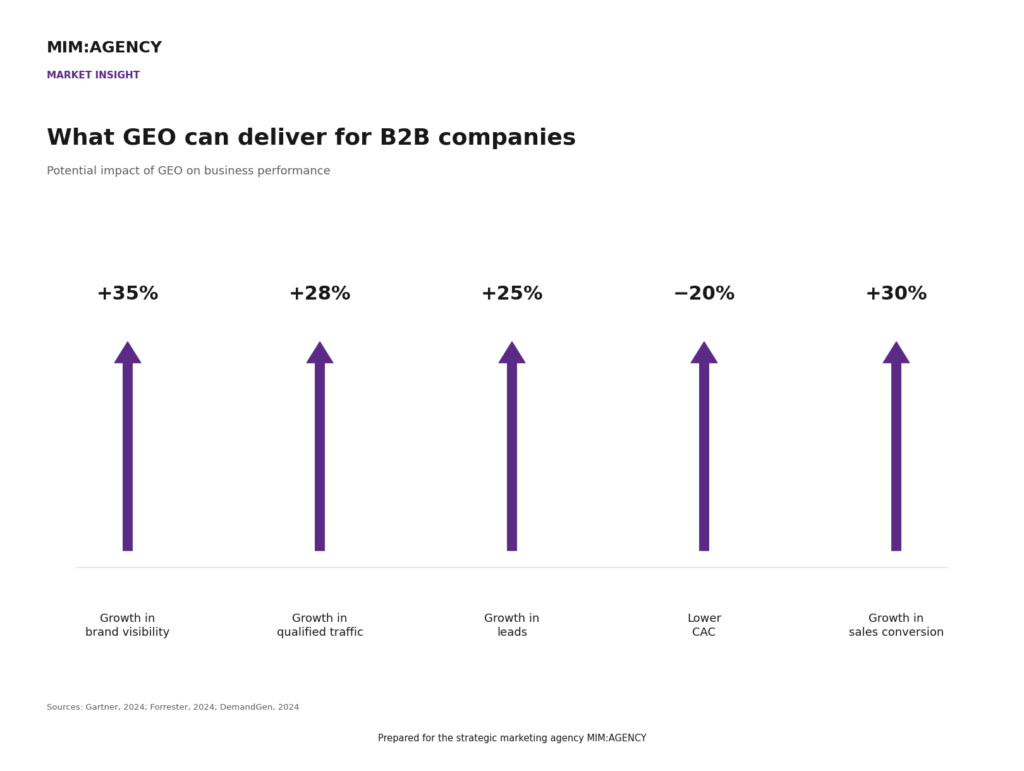
How to Measure What Was Previously Impossible to Measure
Traditional traffic metrics no longer tell the whole story. Google openly acknowledges that visits from AI Overviews are grouped under the general “Web” category in Search Console without a separate tab, even though users coming from these sources typically spend more time on the site. Therefore, GEO measurement should be structured across three levels:
- Visibility – whether the brand is mentioned at all in AI system responses, using a library of 100–300 representative queries.
- Quality – whether the answers are accurate and whether the quotes actually confirm facts about the company.
- Commercial outcome – correlating AI sessions with events in the CRM, rather than just overall traffic.
It’s telling that a cause-and-effect study recorded a roughly 15% drop in traffic to English-language Wikipedia articles following the introduction of AI Overviews – and this is a clear signal that simply measuring “total organic traffic” is now outdated.
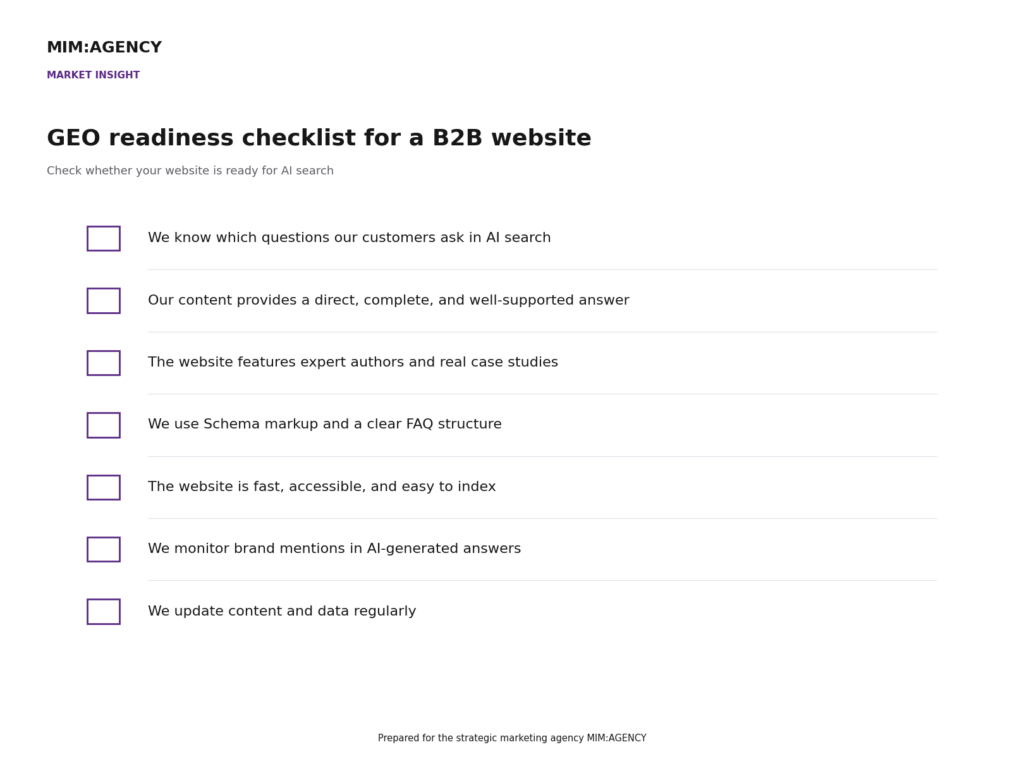
What to Do This Quarter + a Checklist from MIM:AGENCY
- Check indexing, canonical tags, sitemaps, and rendering of critical pages.
- Add or align basic structured markup – Organization, Article, breadcrumb.
- Rewrite key pages in an “answer right at the start” format, rather than the classic introduction.
- Create 20–30 atomic pages targeting the audience’s most important search intent – separate pages for the product, comparisons, and case studies.
- Add author bylines, update dates, and transparent sources to expert content.
- Start regularly monitoring how – and whether at all – the brand is mentioned in AI responses.
Companies waiting for AI search to fully take hold are already losing ground right now. Those who start restructuring today will gain an advantage that competitors won’t be able to catch up to quickly.
The MIM:AGENCY team is already adapting its approaches to content strategies and technical SEO for our clients – so that businesses don’t just keep up with the market, but stay one step ahead of it.
