
GPT, Claude, Gemini, or open-source — who is the market leader among language models?
Large language models (LLMs) are rapidly changing the market — from OpenAI's GPT to Claude, Gemini, and open solutions such as LLaMA or Mistral. Our analysis shows that each model has its strengths — GPT's versatility, Claude's “long memory,” Gemini's multimodality, and open-source flexibility. But at the same time, they all face limitations.
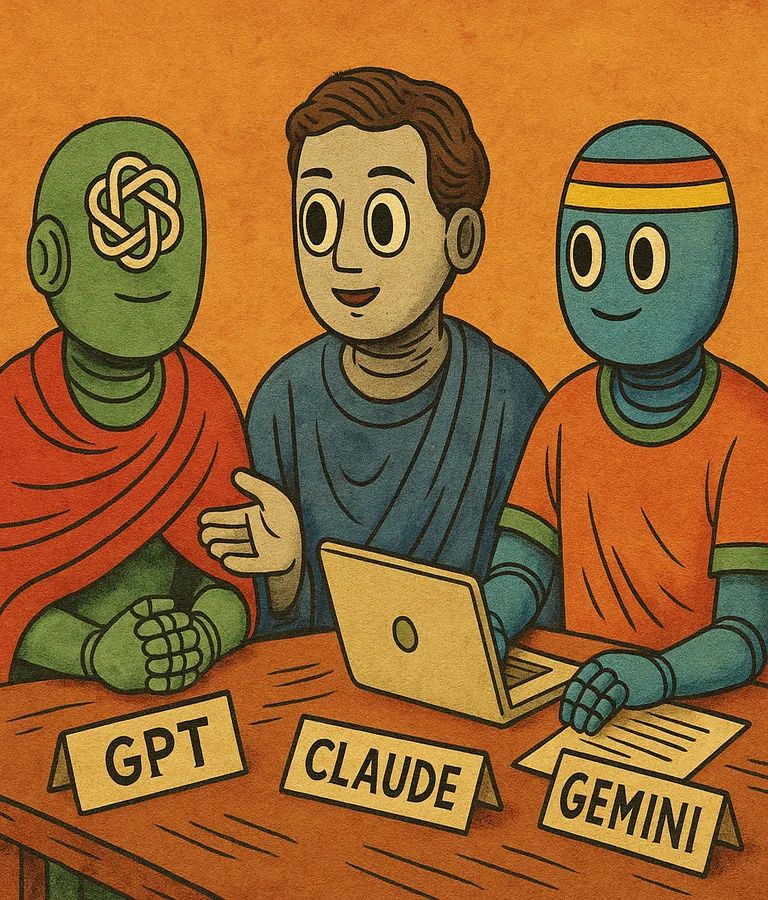
Just a few years ago, the idea that a computer could write an article or hold a meaningful conversation seemed like science fiction. Today, this is a reality thanks to large language models (LLMs) — artificial intelligence systems that have learned to generate text almost like a human. In this overview article, we will explain in simple terms what LLMs are, trace their rapid development, and compare key models: GPT from OpenAI, Claude from Anthropic, Gemini from Google DeepMind, as well as a number of open models.
What are large language models?

Large language models (LLMs) are artificial intelligence algorithms that can understand and generate text. They are called “large” because they contain a huge number of parameters (think of neural “connections”), often billions or even trillions. These models are trained on gigantic arrays of text data: books, articles, web pages, and conversations. In fact, LLM “reads” the internet and many libraries to learn the patterns of human language. After training, such a model can continue your sentence, answer questions, write a poem or program code — in short, generate meaningful new text based on what it is most likely to put next.
The principle of LLM can be simplified to intelligent autocomplete: the model predicts the next words in a sentence based on its experience with training data. But thanks to a complex neural network and billions of examples, this “autocomplete” has become very intelligent. LLM distinguishes between contexts and styles and can follow user instructions. For example, if you ask it to explain quantum physics in “human language,” the model will first recall everything it knows about quantum physics and then formulate an understandable explanation, avoiding overly technical terms.
It is important to understand that LLM does not “think” like a human and does not have its own beliefs or consciousness. It operates on statistical patterns of language. However, with skillful configuration and prompts, it is an incredibly powerful tool capable of performing a wide range of tasks: responding to queries, translating, writing texts in various styles, analyzing data, composing program code, and more.
OpenAI GPT

GPT (Generative Pre-trained Transformer) is a family of large language models from OpenAI that effectively started the current AI boom. The most famous representative is ChatGPT, a chatbot based on the GPT-3.5 and GPT-4 models, which became synonymous with the achievements of artificial intelligence in 2023. Let’s take a look at the power of GPT and its characteristics.
Features and strengths: GPT models are trained on extremely large amounts of data (texts from the Internet, books, encyclopedias, program codes, etc.), thanks to which they have encyclopedic knowledge and can generate coherent, well-constructed answers on almost any topic. GPT is notable for its versatility: it is equally good (within its capabilities, of course) at writing a literary essay, explaining a scientific concept, analyzing a financial report, or generating program code. OpenAI actively retrained GPT with the help of humans (using the RLHF method, reinforcement learning from human evaluation), which made the model’s responses more polite, contextually relevant, and useful to the user. As a result, communicating with ChatGPT has become quite convenient—it remembers the context of the conversation, can clarify questions, and give advice. GPT-4, OpenAI’s latest flagship model, demonstrates a high level of logical reasoning and the ability to solve complex tasks, from passing tests at the level of the best students to writing simple programs. Microsoft has integrated GPT-4 into Bing search and office applications (Word, Excel, Outlook) as a smart assistant, highlighting the practical value of the model.
Usage and examples: GPT-based ChatGPT has become a personal assistant for millions of people. Typical scenarios include writing texts (letters, articles, resumes), generating ideas (brainstorming, suggesting slogans, plots), translation and language practice (you can ask for an explanation of a word, correct grammar, or even practice a dialogue in a foreign language), programming (code generation based on description, code explanation, error search), data analysis (explaining a table, summarizing a report), etc.
Limitations and weaknesses: Despite all its talents, GPT also has its drawbacks. First, it is a closed proprietary model — OpenAI does not disclose the details of the GPT-4 architecture and does not provide open access to the model weights. Interaction is only possible through APIs or services (ChatGPT), which means that users are dependent on OpenAI’s policies and the availability of internet access. Second, using powerful versions (such as GPT-4) is expensive: OpenAI monetizes the model through paid subscriptions and API rates, which can add up to significant amounts for large projects. Third, GPT suffers from “hallucinations” — the model sometimes confidently invents facts or makes logical errors.
Anthropic Claude

Claude is a family of language models from Anthropic, a company founded in 2021 by a group of former OpenAI employees. It is named after cybernetic scientist Claude Shannon. Claude emerged as a competitor to ChatGPT and focused on being a safe and intelligent conversationalist with a long memory. Let’s take a look at how Claude differs and where it is used.
Features and strengths: Claude’s main feature is extended context. The model was designed to maintain attention on very long conversations or texts. While GPT-4 had a context window of 8–32 thousand tokens (in other words, it could process several dozen pages of text at a time), Claude 2 increased this limit to 100,000 tokens (about 75 thousand words!) in 2023. In practical terms, this means that Claude can analyze an entire book or large document in its entirety. For example, Anthropic engineers demonstrated how Claude read the novel The Great Gatsby, which is ~72,000 words long, to which they deliberately made one minor edit — and the model found the changed line in less than a minute! This ability to retain context for a long time and synthesize information across a large body of text is very useful for tasks such as analyzing reports, reviewing large program code, summarizing long correspondence, or even solving multi-step problems where you need to remember all previous inputs.
Another strength of Claude is coherence and politeness. Anthropic has emphasized “Constitutional AI”: they have given the model a specific set of ethical principles (something like a “constitution”) that it follows, self-correcting its responses. This helps it maintain an even, friendly tone and avoid toxicity or bias. As a result, users note that talking to Claude is sometimes “more pleasant,” as it explains things more patiently, refuses less often without reason, and generally maintains long dialogues very well without losing the thread of the conversation.
Limitations and weaknesses: Like GPT-4, the Claude model remains closed. The code and implementation details are not public—Anthropic only provides access to the service. This means that you cannot deploy Claude on your own server or modify it—you can only use it through the developer company. Furthermore, Claude is generally a little less well-known and widespread than ChatGPT, so the ecosystem of integrations and plugins around it is poorer.
Google DeepMind Gemini

Gemini is a family of the latest large language models from Google DeepMind (Google’s combined artificial intelligence division). Google has long been a pioneer in AI (remember their Transformer architecture, for example). However, the arrival of ChatGPT caught the company off guard.
In 2023, Google combined the efforts of its two teams, Google Brain and DeepMind, to create a fundamentally new, powerful brain called Gemini. The first Gemini models were announced in December 2023, and they are rapidly developing in 2024–2025.
Features and strengths: The main difference between Gemini is its multimodality and versatility. While GPT-4 was first trained on text and only then partially trained to perceive images, Gemini was trained on different types of data from the very beginning. It can work not only with text, but also with images, audio, and possibly even video. This means that Gemini is capable, for example, of analyzing an infographic or photograph and answering questions about it, or listening to an audio recording and summarizing it — that is, combining different channels of information. Google reported that Gemini, in its most powerful version, Ultra, outperformed existing analogues on most standard tests. In particular, Gemini Ultra was the first model to exceed human performance on the MMLU (multidisciplinary knowledge test), surpassing GPT-4. Gemini’s success in coding tasks was also reported—the model generates and explains code well in popular languages, using the developments of DeepMind (which previously created AlphaCode).

Another strong point is scalability. Google has introduced Gemini in three main versions: Nano (the lightest, optimized for mobile devices and embedded systems), Pro (medium, for a wide range of tasks with an emphasis on efficiency), and Ultra (the largest and most powerful, for the most complex tasks). Overall, Google positions Gemini as the “most general and capable AI brain” of its generation, which will enhance the capabilities of all of the company’s services.
Limitations and weaknesses: It is worth noting that Gemini is a proprietary Google model, so it is available on the company’s terms (through their services). Google, of course, has no plans to open source it. Also, being very new, Gemini has not yet undergone such massive “testing” by users as GPT or Claude, so unpredictable glitches or biases are possible — time will tell. Although Google claims to conduct testing and ethical controls, remember their previous chatbot Bard at launch — it produced inaccuracies that cost the company reputational damage. So Gemini may also make mistakes at first or not perform particularly well in certain cases.
Open models: LLaMA, Mistral, Mixtral, Zephyr, and others

It is worth talking separately about open-source large language models, because their development is a whole story about the democratization of AI. Unlike closed commercial models (GPT, Claude, Gemini), open models are published with open source code and network weights. This allows anyone to download the model, run it on their own equipment, modify it, or retrain it for their own needs. In 2023, there was a real boom in such models, so let’s list the most notable ones and their features.
Advantages of open models: First, independence and control. An organization can deploy the model on its own and ensure that confidential data does not go to the OpenAI or Google cloud. You can customize the model—for example, retrain it on your own knowledge base so that it operates with specific terminology or knows internal documents. Open models are often cheaper in the long run: you set up the server with the model once and then don’t pay for each request, unlike commercial APIs. In addition, the community actively shares best practices, prompts, and instructions, so anyone interested can learn how to work with open models.
Disadvantages of open models: The most powerful open models (such as Llama 2 70B) still lose to the best closed ones (GPT-4, Gemini Ultra) in complex tasks — the difference is narrowing, but it still exists. In addition, running a 70-billion model requires expensive equipment (such as several high-end graphics processors). Smaller models (7–13B parameters) can be run on a regular PC, but their capabilities are somewhat more modest — they are fine for simple tasks, but they can “get lost” in very complex ones. Another nuance is the lack of guarantees and support: if you use an open-source model, you have no support service or contract — everything is at your own risk.
Conclusion

Large language models have gone from laboratory prototypes to mass tools that are changing our everyday lives. GPT, Claude, Gemini, and various open LLMs — each with its own unique features — are shaping the landscape of AI technology today. OpenAI GPT has shown the world how useful generative AI can be and set a high bar for quality. Claude from Anthropic proved that it is possible to make a model more contextually “thinking” and focused on safe interaction. Google, with its Gemini, shows its ambition to integrate AI everywhere — from search to smartphones — and emphasizes multimodality. And open models, led by LLaMA and Mistral, are democratizing access to AI, allowing everyone to experiment and innovate.

It’s important to remember that none of these models is perfect: they can make mistakes, invent things, and sometimes not understand you the first time around. But with each iteration, these systems are getting better.
Sources:
- Epista Life Science (2024). Comparing GPT, Claude, Llama, and Mistral: Which Large Language Model (LLM) is Right for Your Needs?
- Anthropic (2023). Introducing 100K Context Windows
- InfoQ (2024). Mistral AI’s Open-Source Mixtral 8x7B Outperforms GPT-3.5
- KDnuggets (2024). Exploring the Zephyr 7B: A Comprehensive Guide to the Latest LLM
