
Healthtech Marketing 2026: What Clinics Really Need
General claims about innovation are no longer enough to persuade the healthtech market. Clinics expect measurable outcomes, clear ROI, clinical evidence, secure data practices, and tailored arguments for every stakeholder involved in the buying decision.

Just five years ago, healthtech marketing was relatively simple: show how “smart” the algorithm is, how modern the interface is, and how revolutionary the approach is. Today, that formula doesn’t work – and this isn’t just a subjective impression, but a direct consequence of how the market itself has changed. Healthtech has moved from the “proof-of-concept” phase to the “proven business model” phase, which means that marketing built around “innovation” has lost its ability to persuade.
At MIM:AGENCY, we see this in practice: clinics, insurance companies, employers, and laboratories are already tired of the same old promises that “AI will change medicine.” They want to know one thing – what exactly will change in their daily operations, how much it will cost, and who will be held accountable if something goes wrong. This isn’t a technical question – it’s a marketing question – and whether a lead signs a contract depends on the answer.
Why the “tech-first” message has stopped converting
The main reason is simple: when the entire market speaks the same language, that language ceases to be a selling point. “Innovative,” “AI-powered,” “smart algorithm” – these phrases appear today in the descriptions of virtually every healthtech product, regardless of whether they’re backed by real clinical validation or not. The client senses this and reacts accordingly – with a default distrust.
Instead, the market now measures value in entirely different categories: how many minutes a doctor has saved by cutting out paperwork, by how much the number of readmissions has decreased, how much faster a patient gained access to screening, and how many fewer calls the front desk had to handle. This is the language of operational efficiency, not the language of innovation. And it’s a fundamentally different marketing narrative: instead of “we’ve done something new,” it’s “we’ve eliminated a specific waste of time or money in your process.”
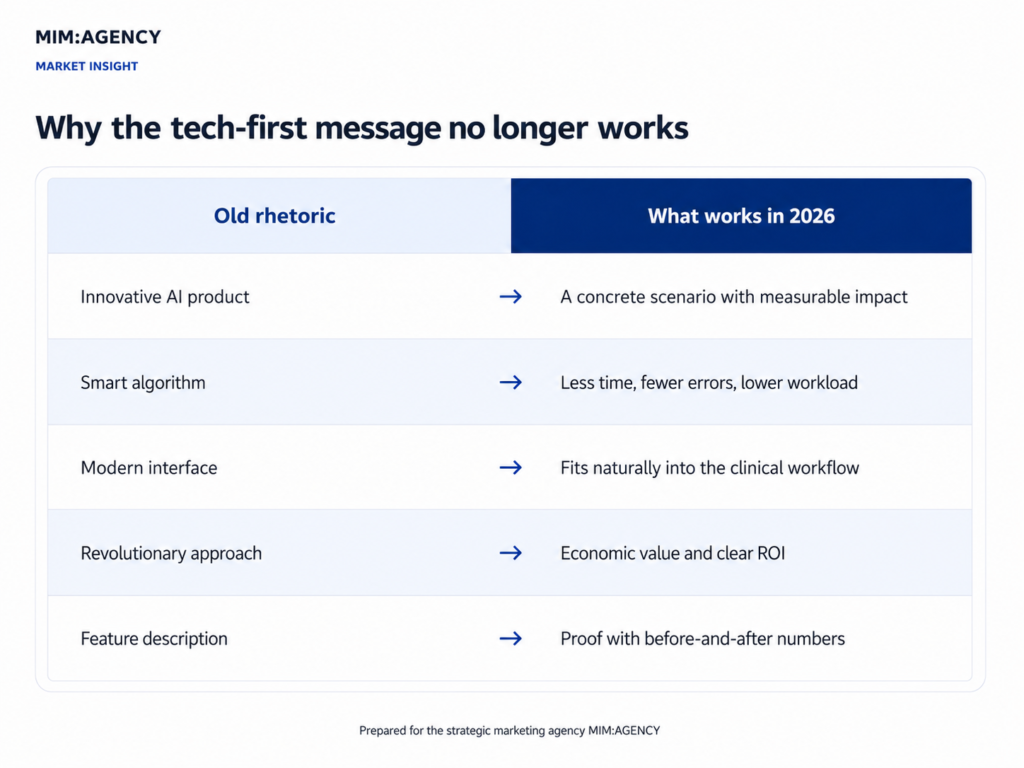
The practical implication for content strategy: the most powerful type of content in this category isn’t an overview article about a technology’s capabilities, but a specific clinical-economic scenario with “before” and “after” figures. Not “our product uses passive AI monitoring,” but “the clinic reduced documentation time by 16 minutes per eight-hour shift and gained half a patient more appointments per week.” The first is a claim. The second is proof.
It’s not just one person making the purchase – it’s a committee
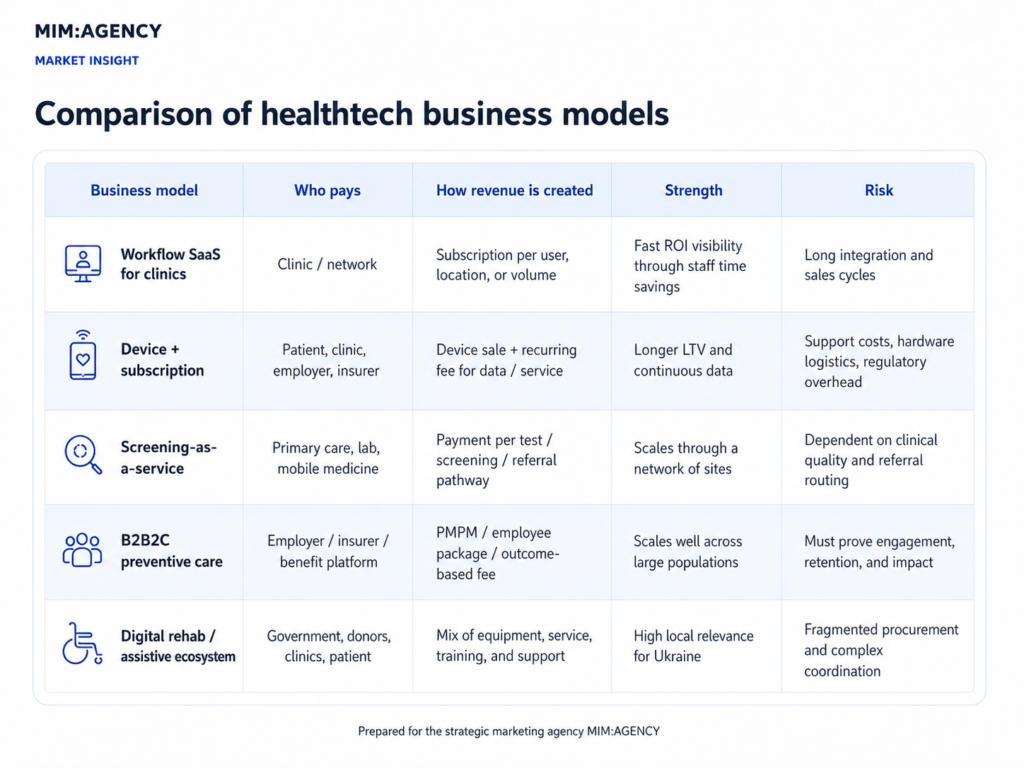
One of the least obvious but most important marketing insights in healthtech: there is almost never a single “decision-maker” here. The purchasing decision goes through a committee – the clinic’s owner or CEO, medical director, IT manager, lawyer, or compliance officer – and often also involves the finance department or an external donor or grant partner, if the organization is in the public or reconstruction sector.
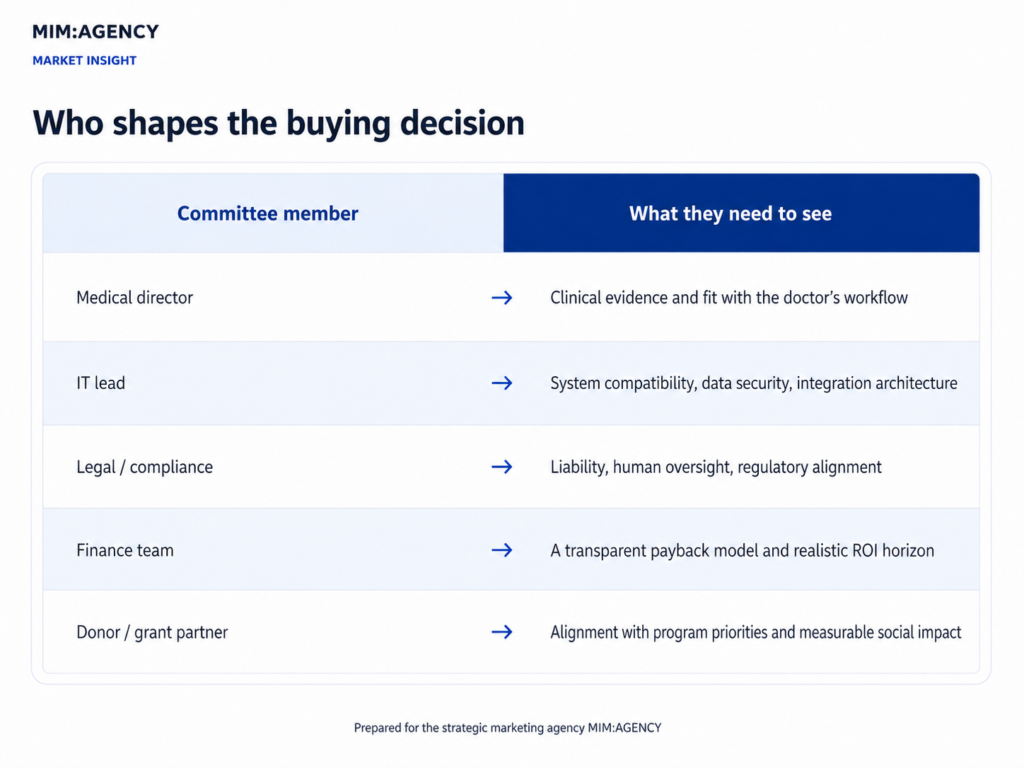
This means that marketing communications designed for a “single buyer” consistently fail in this category – not because they’re bad, but because they’re addressed to only one of the five voices in the room. Each committee member has their own language of trust:
– The medical director wants to see clinical evidence and how the product fits into a doctor’s actual workflow;
– the IT director wants compatibility with existing systems, data security, and a clear integration architecture;
– the lawyer or compliance officer wants accountability, human oversight of AI decisions, and compliance with requirements regarding personal medical data;
– the finance team: a transparent payback model and a realistic return on investment timeline;
– a donor or grant partner, if applicable: alignment with program priorities and a measurable social impact.
Practical implication: The content strategy should not consist of a single one-size-fits-all message, but rather a set of materials tailored to each committee member individually – a brief ROI table for the finance professional, a clinical brief for the physician, an explanation of data security for the IT specialist and lawyer, and a concise trust narrative for the end user or patient. This requires more work during the content preparation phase, but it is precisely this that most often determines whether a deal will be signed or get stuck at the “that’s interesting, let’s discuss it later” stage.
Trust as a Marketing Asset, Not a Side Effect of Service
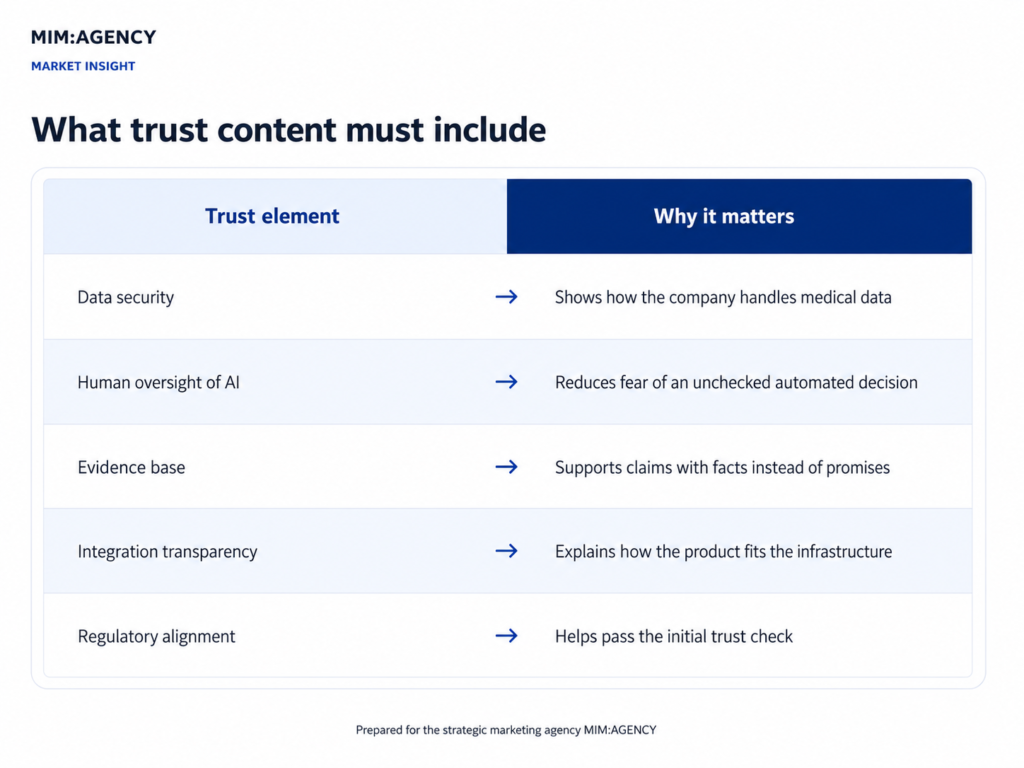
Until recently, trust in a healthtech company was built after the fact – through the quality of post-sale support. Today, the situation has changed: trust must be demonstrated even before the first contact with the sales department. The reason is that the regulatory environment has become stricter and, at the same time, more transparent – and customers are aware of this. They expect not just promises from a supplier, but tangible signs of maturity: a transparent description of how AI makes decisions and where human oversight remains in the process; a clear policy for handling medical data; and a publicly available evidence base – not just marketing claims about effectiveness.
This has practical implications for a company’s website and content: sections on data security, the human role in overseeing AI decisions, the evidence base, and regulatory compliance are no longer just a “legal page tucked away in the footer.” They are part of the top of the marketing funnel, just as much a priority as the product feature description. A company that demonstrates this maturity before its competitors gains an advantage even before negotiations begin – simply because the customer first looks for reasons not to trust, and only then for reasons to buy.
Distribution channels have expanded – and this, too, is a marketing challenge, not just a product one
Another significant change: the classic “sales through physicians” approach remains, but it is no longer the sole – or even the primary – channel for many categories of healthtech products. Alongside this, direct channels to patients have emerged, along with partnerships with employers through employee wellness programs, integrations with insurance programs, collaborations with pharmacy chains and laboratories, and a presence within the government’s digital healthcare infrastructure.
For marketing, this means an expansion of its role: it is no longer limited to generating leads for the sales department. Marketing is now also responsible for partner visibility – presence and content where trust in the entire product category is built, not just in a specific brand. This changes the logic of the content plan: some materials should not be aimed at direct conversion, but rather at positioning the company as part of a trusted infrastructure – one with which partners, insurers, and employers want to be associated.
Five practical takeaways for the marketing director of a healthtech company
First. Stop selling features – start selling a scenario. The most powerful content right now is a specific case study with measurable results, not a general statement about the technology’s capabilities.
Second. Tailor content specifically for each member of the buying committee, rather than hoping that a single message will reach everyone at once.
Third. Invest in trust-building content just as systematically as you do in product content – explaining data security, the role of human oversight, and the evidence base isn’t a formality; it’s part of the top of the funnel.
Fourth. Think beyond the “selling to doctors” channel – partnerships with employers, insurers, laboratories, and digital infrastructure are just as much marketing channels as advertising or SEO.
Fifth. Keep in mind that the decision-making cycle is longer and more complex than in a typical B2B SaaS – this is normal for the category, and the marketing funnel should be designed for several parallel conversations rather than a single linear one.
How we at MIM:AGENCY build this for our clients
We don’t approach a healthtech project with a ready-made marketing template. We build it as a four-step process.
First, we map out the client’s market: who exactly is on the decision-making committee, where the real operational pain points lie in the process, and in which specific scenario the product creates the greatest economic value. This answers not the question “who is our product for,” but rather “in which specific process do we create value, and who within the organization recognizes it.”
Next, we translate the client’s clinical and operational data into the language of each individual stakeholder – using a set of materials: a one-pager, an ROI table, a pilot brief, responses to common objections, and a trust narrative for the end user.
Then, we design the first pilot alongside the marketing strategy for it, ensuring the campaign not only generates leads but also closes deals – with clear success metrics and a scaling plan.
And finally, we build the very layer of trust that most often determines the outcome of a tender or pilot today: content and web pages that demonstrate the company’s maturity – not just its innovation – including data security, the human role in oversight, an evidence base, and transparency in integrations. That’s exactly why we make this layer the foundation of our strategy from the very beginning, rather than leaving it for later.
