
Africa is a potential engine of growth for the world economy
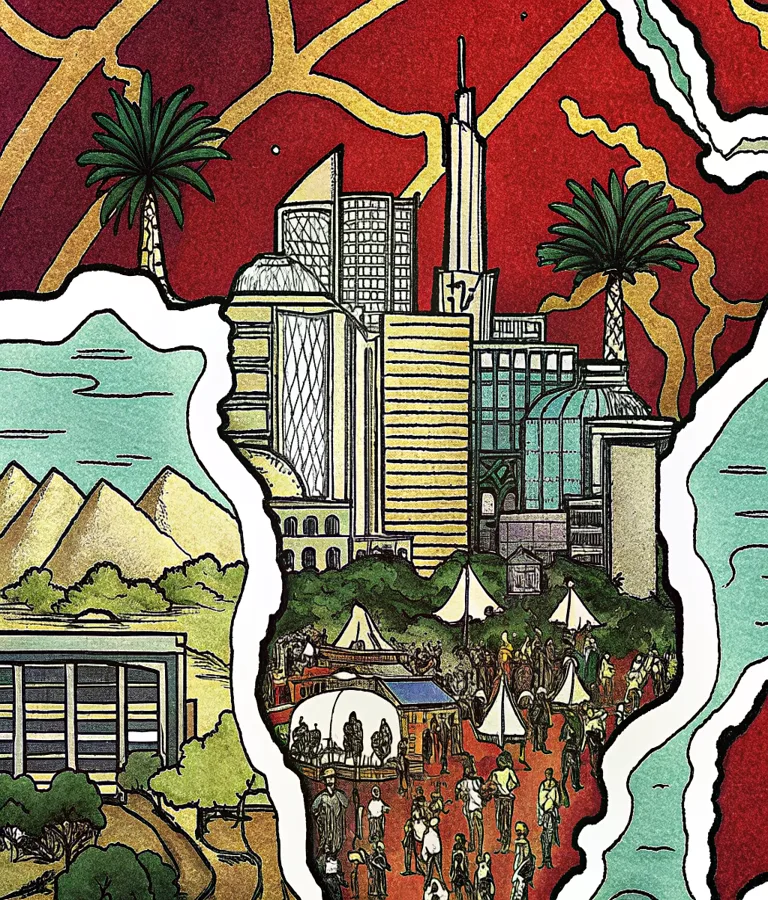
In this paper we will analyse the hypothesis that Africa is one of the last reserves for the modern world economic model. This continent has rich resources, but is technologically backward, and its development can become a driver that can boost the world economy and overcome the long crisis.
Africa presents itself as diverse. Many countries on the continent, freed from colonialism, have faced internal challenges — internecine civil wars, clan rivalries and corporate competition for resources. It is important to realise that the economic, social and cultural differences between them can often seem like centuries apart.
The continent can be divided into the following macro-regions:
- North Africa (including the Sahel, Maghreb, and Horn of Africa);
- West Africa;
- Central Africa;
- East Africa;
- South Africa.
In each of these regions, there are economic leaders, outsiders, and countries that are unable to provide an adequate level of stability.
Take South Africa, for example:
South Africa
The Republic of South Africa (RSA) is one of the most developed nations on the continent and a member of BRICS, but is now facing economic difficulties. Contradictions between the indigenous population and the Boers have reached a critical point. Since the end of apartheid and the first democratic elections in 1994, the country has been undergoing rapid change. The problems and social changes are particularly visible in Johannesburg, where former business centres have become housing for many commuters from the surrounding area.
Rwanda
Rwanda is one of the fastest growing countries in the region from an economic point of view. Our company has implemented a Smart City project in Kigali, the capital of Rwanda.
An example of the country’s positive development is a project aimed at providing full electricity by 2024 and increasing the installed capacity to 512 MW. Part of the energy is planned to be extracted from Lake Kivu, which has large reserves of carbon dioxide and methane. Economic improvements in Rwanda are attracting international investors and large energy companies.
Mozambique
Mozambique has serious natural gas reserves, which has attracted the attention of investors from other nations. However, the country has also faced challenges from IS militants and radical groups, especially in the province of Cabo Delgado. This has led to the destruction of infrastructure, including telecoms equipment from operators Vodacom and Movitel.
Thus, we see that the South African region requires active attention as well as investment to advance economic development and overcome challenges.
Why is it worth talking about Africa?
Some reputable economists believe that the capitalist economic model reached its limit at the beginning of the twentieth century.
The First and Second World Wars drove growth in consumer demand and production. Many countries were destroyed, but their reconstruction helped to maintain the existing world economic model.
Then came a new stage of development, caused by the collapse of the Soviet Union and the relocation of production to the Asia-Pacific region. These developments opened up new markets and lowered production costs due to cheap labour. The economic model continued to exist.
In the future, Africa’s development and the development of its markets could be the next important stage in supporting the world economic system. However, this is hampered by a number of challenges:
- confrontation between global centres of power;
- non-transparent financing and comprehensive corruption at all levels of government;
- low level of technological development;
- cultural, religious and social contradictions in many countries;
- complex epidemiological situation;
- insufficient transport infrastructure;
- low level of urbanisation of the population;
- high illiteracy rate among the population.
Despite the difficulties, the global economy is generally interested in developing such vast new markets. These problems are to be solved within the next 30–50 years.
Let’s briefly consider each problem:
1. Confrontation of global centres of power
The main confrontation between the US, China, and Russia is developing on the continent. Italy, France, and the UK are also influential. The countries are actively expanding their presence in the region through economic and military initiatives. The main task is to reach agreements on the division of spheres of influence.
2. Non-transparent financing and total corruption in all echelons of power
Transparency and targeting of direct investment is a necessity in the fight against corruption. An example of a positive step in this direction is the World Bank’s Private Equity and Venture Capital Initiative in the countries of the West African Economic and Monetary Union.
3. Low level of technology development
Improving internet coverage is considered an important aspect of economic growth on the African continent. A number of countries are already experiencing high mobile internet speeds, and the construction of the 2Africa submarine cable could provide faster and more affordable internet to 16 African countries by 2024.
4. Colossal cultural, religious and social contradictions
Virtually every state in the world, including not only Africa, reveals pain points in the cultural, social and religious relations between peoples living on the territory of one state. The principle of “divide et impera” is always relevant.
Let us list some countries and parties to the conflicts to better understand the scope of the problem described:
Central African Republic
“Seleka” versus “Antibalaka” — conventional Christians versus conventional Muslims. The “Seleka” have now split into a dozen small groups, but the essence of the conflict remains unchanged.
This long internal civil conflict concerns Muslim trading circles and the raw Christian elite of the metropolitan south, vying for resources and state infrastructure. The conflict is complicated by the intervention of multiple foreign forces.
Democratic Republic of the Congo
It is the most brutal war, which is called the Great African War. It lasted from 1998 to 2002, killed more than 5 million people, and is still going on today.
Today, it is a conflict between the Nande and the Kobo-speaking agriculturalists who compete for resources with the Banyamulenge, the Allochton pastoralists. We can think of the “Renewed Congo Defence Force-Nduma” (NDC-Rénové) under the command of Gidon Chimire.
External forces naturally support the conflict. In particular, Rwandan special forces are an active participant in the confrontations.
Mauritania
This State is rarely mentioned in the Foundations for Democracy and Human Rights. Medieval slavery still thrives there.
Up to 50% of the population are Haratines, black slaves, while the “titular” Beydan Moors (white people) are of Arab-Berber origin. Interestingly, they speak the same language, Hassānīya. At the same time, the lower castes of the Beydan Moors have no slaves, but freed slaves-haratin easily become slave owners.
This horrible “cultural” and societal tradition has never been changed, neither by the colonising French nor by the many foundations of Western democracies that operate in the country and choose to turn a blind eye to slavery within the state in the 21st century.
Mali
Mali faces many internal conflicts that have coalesced into a global confrontation between the “jihadist” Fulbe and the Dogon hunters. The authors of Zangaro Today mention, “Behind every people inhabiting this country are not only language and culture, but also economic systems, ecology, ethnic groups and cosmology.”
The “archaic” Dogon and the “cosmopolitan Fulbe” temporarily came into conflict over the expansion of the desert. As a consequence, radicalism, competition for resources and ethnic cleansing developed.
5. Complex epidemiological situation

It is common knowledge that sanitation conditions in many countries in Africa leave much to be desired. In September 2019, the United Nations Interagency Group for Child Mortality Estimation (UN IGME) and the United Nations Interagency Group for Maternal and Child Mortality Estimation (UN MMEIG) published the Child and Maternal Mortality Estimation Reports.
Nigeria, Somalia, Chad, the Central African Republic, Guinea, Sierra Leone and Chad are among the countries with the highest under-5 mortality rates, with more than 100 deaths per 1,000 live births. This rate is 20 times higher than the under-5 mortality rate in high-income countries (5 deaths per 1,000 live births).
According to 2017 data, the leaders among countries with the highest risk of childbirth are Chad (1 death per 15 women) and South Sudan (1 death per 18 women).
Multiple relevant organisations estimate that at least 10% of the populations of Botswana, Malawi, South Africa, Mozambique, Lesotho, Namibia, Eswatini, Zambia, and Zimbabwe are infected with HIV.
In 2015, there was an outbreak of Ebola in the Democratic Republic of the Congo that killed many people. In June 2020, the World Health Organisation declared that there is a high probability of a second outbreak of the disease.
According to the ICRC statement, regions where armed conflicts are taking place are of particular concern, as many hospitals have already been damaged or destroyed, and clean water and soap needed to fight viruses are in short supply.
In northern Mali, for example, 93% of health facilities have been destroyed, while in Burkina Faso, where people in several regions of the country have been forced to flee, pressure is mounting on health systems in certain areas as the population of the city of Djibo has doubled due to internally displaced persons.
6. Lack of necessary transport infrastructure
The importance of transport infrastructure for the countries of the African continent cannot be overestimated, especially in the context of increasing globalisation and the active participation of African countries in world trade. The development of a market economy is impossible without a well-developed and functioning transport network.
Market relations link countries both within and outside the continent. Currently, the main needs of intra-continental markets are met by road transport.
Let us briefly review the current state of infrastructure and assess the prospects for its development with respect to the main modes of transport:
Road transport
Road transport in Africa provides about 75% of freight and 80% of passenger transport, with volumes increasing by 4-6% annually.
According to webeconomy, Africa has a low road density per square kilometre. This indicator is dozens of times inferior to developed countries. The countries with higher road density per square kilometre are Mauritius (1,000), Rwanda (0,532), Burundi (0,442), Senegal and Mozambique (0.730 and 0.385 respectively). However, Burkina Faso (0.005), Sudan (0.008) and Mali (0.015) have the lowest rate.
To develop transport infrastructure on the continent, the United Nations has established a coordinated road development programme, which includes several trans-African highways:
- Cairo — Gaborone (via Egypt, Sudan, Ethiopia, Kenya, Tanzania, Zambia, and Botswana);
- Casablanca — Suez (via Morocco, Algeria, Tunisia, Libya, and Egypt);
- Mombasa — Lagos Trans-African Latitudinal Railway (via Kenya, Uganda, Democratic Republic of Congo, Central African Republic, Cameroon, and Nigeria);
- Lagos — Nouakchott Trans Coastal Highway (via Nigeria, Benin, Togo, Ghana, Côte d’Ivoire, Liberia, Sierra Leone, Guinea, Guinea-Bissau, Gambia, Senegal, and Mauritania);
- Nouakchott — Ndjamena Trans-Sahelian Motorway (via Mauritania, Senegal, Mali, Burkina Faso, Niger, and Chad);
- N’Djamena — Djibouti (via Chad, Sudan, Ethiopia, and Djibouti);
- Tripoli — Windhoek (via Libya, Chad, Central African Republic, Central African Republic, Republic of Congo, Democratic Republic of Congo, Angola, and Namibia);
- Beira — Lobitu Trans-South African Highway (via Mozambique, Zimbabwe, Zambia, and Angola);
- Algeria — Lagos Trans-Saharan Highway (via Algeria, Niger, and Nigeria).
However, the overall condition of roads does not meet the needs of the economy, and vehicle maintenance is characterised by high cost and poor quality.
Among the main concerns:
- Poor quality of road surfaces.
- Many roads do not have year-round passability.
- Lack of proper maintenance of roads.
- Shortage of qualified engineering and technical personnel.
- Inefficient organisational structures in road management.
Railway transport
Rail transport in Africa is relatively underdeveloped. The total length of lines in operation is about 70,000 km, which is only 7% of the world’s total railway length, despite the fact that the continent is home to about 14% of the world’s population and occupies 22% of the world’s land area.
For example, South Africa’s largest state-owned railway company, PRASA, is on the verge of bankruptcy. It is facing serious financial problems due to mismanagement and poor customer service. As a result, the Department of Transport has decided to impose external management on the company for a period of one year. The issues at PRASA led to a severe financial crisis and mass layoffs of employees.
Nevertheless, thanks to investments from China, the region’s railway sector is showing positive trends. The PRC is actively financing several projects aimed at developing railway infrastructure on the continent.
Among the implemented projects, the following should be noted:
- Addis Ababa — Djibouti railway line ($4 billion investment). Contractors: China Railway Group and China Civil Engineering Construction Corporation.
- Reconstruction of the Benguela railway (investment of $1.83 billion). Contractor: China Railway Construction Corporation.
- Addis Ababa Light Rail (investment: $0.48 billion). Contractor: China Railway Group Limited.
One of the main problems is the different gauges on the continent’s railway lines. This makes transit transport of passengers and freight difficult. The gauge ranges from 1,000 mm (Burkina Faso, Côte d’Ivoire and Djibouti) to 1,435 mm in countries (Guinea, Morocco, and Egypt).
The exceptions are regions in the south and north of the continent where railway systems have been standardised for historical reasons related to the colonisation of these countries.
Overall, despite the challenges, investment from China and other states, as well as the construction of new railway lines, is helping to improve infrastructure and support the development of the transport network on the African continent.
Maritime transport
Containerisation is slowing down globally, while at the same time Africa continues to show growth. The continent’s 38 landlocked countries have more than 80 ports for international and regional trade. All ports are organised into three regional associations — North Africa, East and Southern Africa, West and Central Africa. In 2001, they formed a single Pan-African Port Cooperation Association.
A number of factors limit the competitiveness of African countries in the world market compared to developing countries in Latin America and Asia. One of the main ones is the underdeveloped transport sector. The average cost of freight in Africa is 47 per cent higher than in other developing countries and twice as high as in developed countries. The transport problem is particularly acute for the 15 inland countries because of the high cost of land transport.
Management contracts and concessioning are common. Private enterprise widely covers loading and unloading operations. In conditions of underdeveloped infrastructure, the possibility of attracting private capital for the construction of new specialised terminals plays an important role. Many projects involving private foreign investors for the construction of container terminals in the ports of Cotonou (Benin), Douala (Cameroon), Abidjan (Côte d’Ivoire), Mombasa (Kenya), Port Harcourt (Nigeria), Dakar (Senegal) and Lomé (Togo) are already underway or planned.
The main issue is the lack of the necessary level of infrastructure, with only 59 per cent of seaports having container terminals. Only the port of Durban in South Africa has a container fleet of over 1 million TEU. Egyptian ports also have large fleets, but most countries have less than 50,000 TEU.
In the perspective of transport infrastructure development, the following planned projects can be mentioned:
- Morocco Expressway ($1.9 billion). Investors: France, Saudi Arabia, Kuwait, UAE;
- Trans-Kalahari railway ($15 billion);
- Bagamoyo Port ($11 billion). Investors: China Merchants Holdings International and the State Reserve Fund of Oman.
Despite a myriad of challenges, the transport industry in Africa is growing inexorably under the pressure of large investments, especially from China. The continent has huge reserves of undiscovered natural resources, so the construction of new transport projects is a necessity and a matter of time.
7. Low level of urbanisation of the population
Advances in technology arise where there is a constant need to solve complex problems in limited space, facing overcrowded areas and other problems that do not arise with rural dominance.
Urbanisation (from Latin urbanus — urban) is an increase in the number of urban population compared to the rural population. It is not only a growth in numbers, but also a qualitative superiority of the level of science and technology. It is a change in social structures, a rejection of archaic approaches in favour of technological breakthroughs, advanced thinking and actions.
Information on the rate of urbanisation in Africa is rather contradictory. According to the UN urbanisation ranking, the most urbanised country in Africa is Gabon (89%), while the least urbanised country in the world and in Africa is Burundi (13%).
The overall level of urbanisation of the continent ranges from 50 to 60% in different sources. A society in which the values of rural life are passed down from generation to generation cannot achieve technological breakthroughs. People who adhere to such values think and act on a different plane. This is why many developing countries are offered a medieval cult presented as authenticity and reject the possibility of technological and progressive development.
8. Appalling levels of literacy
The literacy situation varies from country to country on the continent. Botswana, Equatorial Guinea and Namibia have relatively high literacy rates of around 90%. The best results were achieved in the Seychelles at 96% and in Libya during M. Gaddafi’s rule at 95%.
However, most countries face this problem. For example, Chad, CAR and especially Niger. But the situation is not hopeless. There is a striking example of the successful fight against illiteracy in Somalia under the Siad Barre regime. In 1972, the Somali language was adapted from Arabic to Latin script for convenience, and a vigorous literacy campaign was launched. Many textbooks were also printed. By 1974, the literacy rate had risen from 5% to 70%.
Thus, it becomes obvious that a systematic approach allows us to solve this problem.
Conclusion
In conclusion, we would like to add that Africa may well become one of the growth engines of the world economy. That is why it is so important for Ukraine to develop its own policy of interaction with the countries of this continent. It is necessary to form a strategy of political, social and cultural actions that will allow us to become a significant player on the continent.
