
The most detailed TikTok promotion guide

__________
Is TikTok just a social network for teenagers? Why is there so much talk about it, and how has TikTok managed to change other social networks and the world of show business in general? We will not only answer these questions but also provide a complete guide to entering this social network. Buckle up, we’re diving into the world of Generation Z!
Most likely, what you’ve heard about TikTok is that it’s an app where teenagers make silly videos to music, and it pushes its ads everywhere. But that’s not entirely true.
TikTok is a Chinese social network where you can shoot short music videos, stream live, and communicate. Its main goal is to gain likes, followers, and interact. It was launched, initially under the name Douyin, by the Chinese company ByteDance in September 2016. In 2017, the social network entered the international market under the name TikTok, and in 2018, after merging with Musical.ly, it already had 800 million daily users, compared to Instagram’s 500 million active users. It took them one year to achieve this, while it took Instagram 9 years.
This app became the leader in downloads in the U.S. in 2018, surpassing not only Instagram but also YouTube and Facebook in the rankings. It was at that point that it caught the attention of many media outlets, with Business Insider calling the service a ‘viral app you’ve probably never heard of.

Statistics
A few numbers… As of November 1, 2019, according to Statista, the highest number of app downloads occurred in India (190.6 million), followed by the United States (41 million), Turkey (23.2 million), Russia (19.9 million), and not far behind, Mexico with 19.7 million.
As of mid-November 2019, the number of downloads on Google Play and the Apple Store reached 1.5 billion times.
The largest audience is people aged 18-24, making up 42% of TikTok users, followed by those aged 13-17 at 27%. The 25-34 age group accounts for 16%. Although there aren’t many older users, their presence is surprising. 8% are aged 35-44, 4% are 55+, and 3% are 45-54 — representing an older generation keeping up with the times, and their dedication to trends is admirable.
Gender distribution: 40% male versus 42% female users. The app is most frequently used by Apple owners — 54%, compared to 46% on Android devices. The average session duration is 46 minutes, and 90% of users open it several times a day. Lastly, the most extravagant fact: each social network user watches an average of 37 million videos per month.


Step by step on how to work with the app:
You can register using:
- Phone number / email address;
- By logging in through other social networks.
After registration:
It immediately offers the ‘Home’ section, where all the popular recommended videos with many likes are gathered for viewing. You can also share the app with your contact list.
App appearance:
It resembles any other social network. All buttons are located at the bottom, their placement is completely logical and intuitive.
- Icon with a house – returns to the home page, i.e., the feed with endless videos;
- Icon with a magnifying glass – search and explore. This section shows popular hashtags and challenges;
- The middle icon with a plus – recording and editing videos;
- Messages – for communicating with friends;
- And ‘Me’ – personal profile. You can create or change your nickname, add information about yourself.

Video Editing:
- Video Length: This is adjusted using sliders to select where the video starts and ends.
- Speed adjustment: There are three modes: 0.5x for slow motion, 1x for normal speed, and 2x for fast motion.
- Video rotation: You can rotate the video to make it horizontal instead of vertical, and also ‘flip’ the video 360 degrees.
After editing the video, click ‘Next’.
Available features:
- Selection of front or rear camera.
- Speed adjustment effect.
- If there are blurs in the recording, the beauty effect can remove them.
- Timer – frees your hands.
- Button to go live.
- Numerous completely free filters and effects.
Music:
- You can use the suggested music from various genres by simply clicking the checkmark next to it. These tracks are already trimmed to 15-30 seconds.
- Alternatively, you can select and upload your own music, adjusting it to fit your video.
- You can also mute or increase the volume of sounds in the video itself.
Video length:
- 15 seconds;
- 60 seconds;
- You can create a video with custom timing within this range.
To make your video more interesting, you can apply a color tint effect to the entire shoot. In total, you have the option to choose between 36 shades.

Video categories
TikTok has borrowed the best features from other social networks: stories from Instagram, masks from Snapchat, and other apps with vertical videos. It doesn’t have a web version, so it exists only on smartphones. After downloading and installing the app on your phone, you can watch videos without registering, but to post your own videos and customize preferences, registration is required. The main section is the feed, and that’s where you end up immediately after installation. No registration forms, just a stream of countless videos, and right away featuring stars (in Ukraine, Nastya Kamenskykh demonstrated a transformation from a casual bathrobe look after washing to a glamorous star with makeup, twirling a chain in her hands. It’s quite amusing to watch).
Videos are presented in the following categories:
- Clips, recording oneself to music;
- Vines, short videos about funny life moments;
- Talented and unique skills;
- Relationships, a topic that always interests young people.
AI Algorithms
In the ‘Search’ section, all hashtags that may be of interest to the user are gathered. The algorithm tracks user behavior and video views by hashtags, and based on this, shows ranked results. The algorithm can adjust user preferences based on a closed data loop. It offers everything they like, and in turn, they provide everything that the algorithm favors. Then comes a moment when the user can no longer distinguish their own tastes from those of the algorithm – and the loop closes.
There is also this system: it doesn’t matter how many followers you have, every video gets distributed in the recommendation feed. This means that a video by a blogger with 100,000 followers might only get a thousand views, while at the same time, a video by a newcomer can ‘go viral’ and gain millions of views
How to gain popularity?
It’s important to understand that this is also a social network, and you need to approach it with full seriousness. Ask yourself why and for whom you are creating content. Think about who your target audience is, what their preferences are, and what they do in their free time. Define the concept of your channel and try not to deviate from it.
In the profile header, set a theme, photo, and your nickname. It should be simple, concise, and memorable. You also have 80 characters to explain why you are worth your viewers’ attention.
To be able to track statistics, switch to a pro account and select a category.

The largest comprehensive format for rapidly promoting a brand or a major blogger is a six-day hashtag challenge. It includes:
- A promotional banner, whose link leads to the challenge (this can be either an internal or external page);
- A block with the challenge from the official page in the search section;
- A page where all content with the hashtag is gathered, along with the total number of views;
- Landing Page — a promotional page for the brand within the hashtag challenge;
- A verified brand account with the ability to leave an active link in the description;
- A music track for the challenge (it can be created specifically for the challenge).
- The banner and hashtag exist for 6 days, after which they disappear, but the main challenge page remains. The official videos pinned by the advertiser at the start of the challenge are the first to be visible on the main page. These usually explain what needs to be done to participate.
The banner and hashtag exist for 6 days, after which they disappear, but the main challenge page remains. The official videos pinned by the advertiser at the start of the challenge are the first to be visible on the main page. These videos usually explain what needs to be done to participate.
Another interesting way to promote your brand is through influencer integration. For integration with a blogger, you can either use a suggested track or your own. All bloggers, and later challenge participants, will film videos using it. The jingle must be creative and have viral potential. This will increase user engagement and allow them to create positive associations with the brand.
But to become a star on this platform, it’s not necessary to collaborate with bloggers or put in effort for challenges. TikTok algorithms don’t just show popular videos — newcomers also have a chance to be noticed. For example, the famous German sisters Lisa and Lena Mantler, who create videos where they dance or lip-sync to music. In fact, in 2017, they were nominated for the Teen Choice Awards for this. That’s how TikTok creates new stars.

Moreover, TikTok creates popular music. As soon as a song becomes popular on the app, it immediately climbs the music charts. This has already been actively utilized, with music being created specifically for this service or using it to promote albums. This is exactly how the singer Lil Nas X became popular with his song ‘Old Town Road.’ For several weeks, he promoted the song as a base for TikTok, and soon users began creating videos with that music. As a result, it reached number one on the ‘Billboard Hot 100’ and stayed there for a long time.
And on November 4, 2018, in Spain, TikTok partnered with the MTV European Music Awards — during the broadcast, the app’s logos appeared frequently.
An interesting fact is that in January 2019, Quartz released a study showing that in recent years, the average length of songs on the ‘Billboard Hot 100’ chart has been decreasing. This phenomenon can also be linked to the rise of streaming platforms like Spotify and Apple Music, which pay the same amount per song play, regardless of the song’s length.

Let’s summarize.
Free methods:
- Be active: like, comment, follow. These methods may no longer be as effective in Instagram, but they still work actively on TikTok.
- If you have a large audience on other social networks, share the link to your TikTok profile there.
- Participate in challenges, follow trends.
- Host live streams, polls — use all available tools to maximize audience engagement.
- As mentioned earlier, keep an eye on trends and record reactions to other people’s videos.
- Collaborate with bloggers to create joint videos.
- Use cross-promotion.
- Share your videos on other social networks and ask people to follow your TikTok.
Paid methods:
- Of course, you can always boost your stats. The most common services for buying followers and likes are: All-SMM, tik-top.com, tiktok-free.com. But remember, don’t boost more than 100 likes or followers per day, or you may risk getting banned.
- Advertising with a blogger: Find a blogger in your niche and ask them to send their rate card.
- Host contests and giveaways.

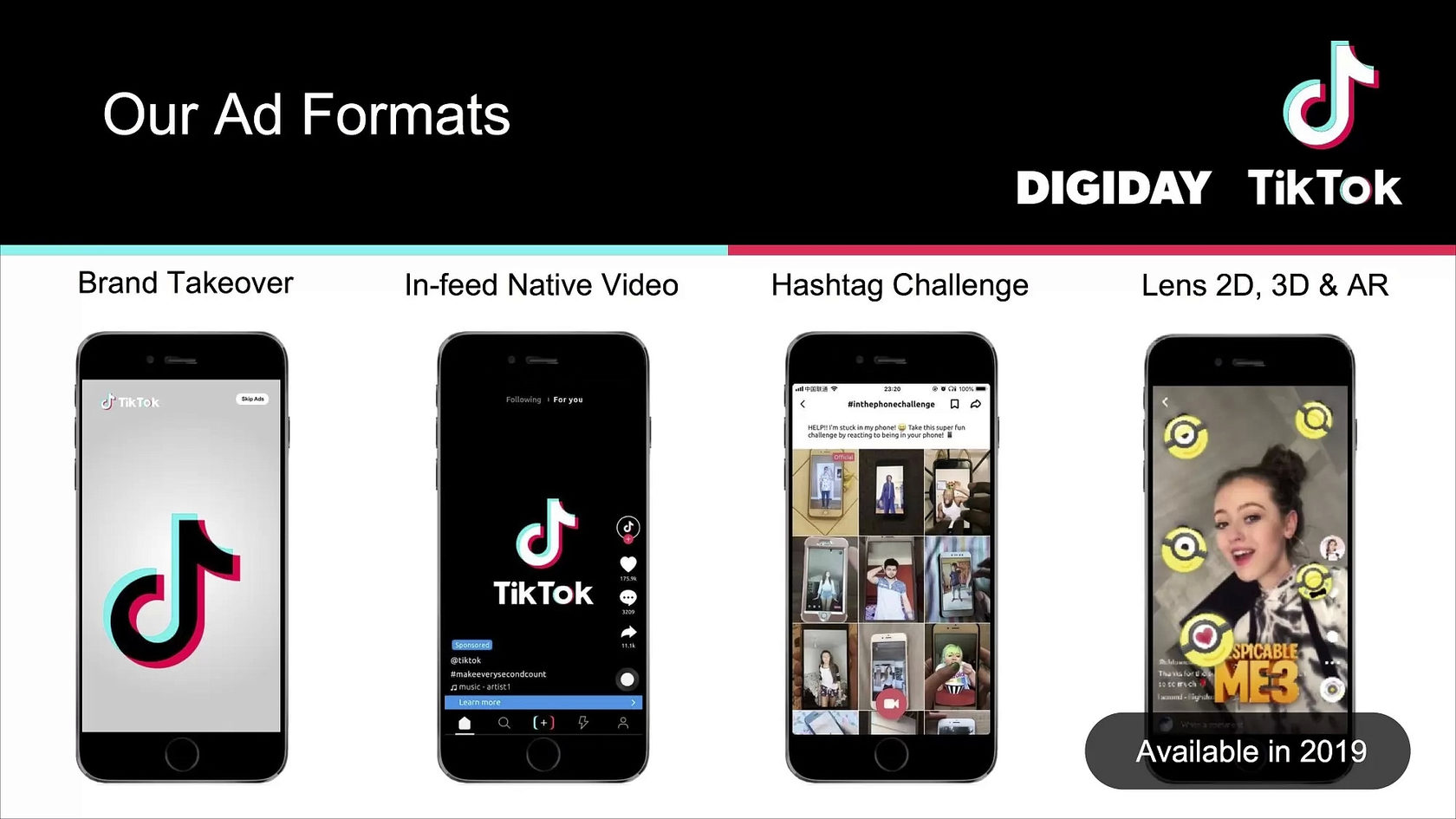
Advertising opportunities:
- Hashtag challenges; Brand Takeover – an image or short (three to five seconds) video that appears when the app is opened;
- In-feed Native Video — pop-up ads in the feed while viewing content (similar to promoted posts in other social networks);
- Branded lenses, masks, stickers.
Advertising campaign case studies:
Guess
The first brand to launch an advertising campaign in partnership with TikTok was Guess. The challenge was conducted under the hashtag #inmydenim, with influencers filming branded videos encouraging American TikTok users to join them.
According to Iris Yen, Senior Director of Social Media at Guess, the challenge received up to 10 million interactions, of which 9.5 million were attributed to the branded video, and the CTR (Click-Through Rate) was 16.5%. Overall, 5,500 videos were created, garnering 30 million views.
Pepsi
As we mentioned earlier, TikTok is most popular in India. Pepsi, which had long struggled to build a connection with Indians, launched a dance video on YouTube that garnered 150 million views. They then encouraged users to recreate the dance in their own style on TikTok. Now, sit back and relax. The hashtag #SwagStepChallenge gathered 23 billion views! Naturally, Pepsi’s sales skyrocketed as a result.
Coca-Cola
In this regard, Pepsi’s main competitor fell a little behind but still achieved impressive results. By launching the hashtag #sharecoke, under which users were encouraged to post funny videos with a bottle of soda, Coca-Cola gathered 6 million views for the hashtag.
Many brands have recognized the importance of this social network and are already present on it, such as Disney, Universal, Warner Bros., and others. Currently, there is relatively low competition for user attention on TikTok, with low promotion costs and large reach compared to other social networks. However, this may change in the near future.

The top videos of 2019 according to TikTok.
Top viral video
https://www.tiktok.com/@daviddobrik/video/6740695967936400645?refer=embed
Best meme
https://www.tiktok.com/@spellmantwinz/video/6676919610639387910?refer=embed
Celebrities
https://www.tiktok.com/@willsmith/video/6746659001880104197?refer=embed
Artists
https://www.tiktok.com/@crusoe_dachshund/video/6688675656584137990?refer=embed
Breakout content creators
https://www.tiktok.com/@glitterandlazers/video/6749527811020672261?refer=embed
Dance trends
https://www.tiktok.com/@oceangela/video/6669835885288099077?refer=embed
Creative effects
https://www.tiktok.com/@eliottbrown/video/6740682326063336709?refer=embed
Animal videos
https://www.tiktok.com/@strykerthecat/video/6748796433748610310?refer=embed
Makeup
https://www.tiktok.com/@abbyrartistry/video/6706189228855790854?refer=embed
Sport
https://www.tiktok.com/@brodiesmith/video/6725928142323666182?refer=embed

It was only a matter of time before a social network emerged that would replace all the existing ones. Video is becoming an increasingly popular type of content, and this might explain the phenomenon of the app’s popularity. Of course, ease of use and the ‘wow’ factor played a role for teenagers, who find it important to feel ‘cool’ and significant in their peer group. Whether TikTok will become the next Vine remains to be seen. But in any case, it’s a social network that will surely stay at the top of the download charts for a long time, and it deserves attention.
